Woodstock Inn & Resort
Woodstock village
The village base for the Woodstock gravel loops and the Mount Tom carriage roads.
Check ratesPeak color moves across Vermont from the high Northeast Kingdom ridgelines in late September to the southern valleys by mid October, and a bike is the best way to be standing in the middle of it.
Short answer
Plan a Vermont fall foliage bike tour for late September to mid October. The Northeast Kingdom turns first, southern valleys last, and the statewide peak window runs roughly the first week and a half of October. Ride rail trails for safe foliage miles, book lodging early, and check daylight, because sunset sits near 6:20 in early to mid October.
The most reliable foliage forecast in Vermont is elevation, not the calendar. Ridgelines in the Northeast Kingdom run ten to fourteen days ahead of the southern valleys, which means the state holds rideable color for close to three weeks if you follow the leaves downhill. A cyclist can cover that gradient in a single long weekend: one day on a Kingdom singletrack loop, one on a Lamoille Valley rail trail town hop, one on a wooded road loop out of Woodstock or Manchester. This guide lays out the timing, the routes, the traffic reality, and the lodging logic for a fall foliage bike tour in Vermont, with everything a rider needs to plan around the shortening daylight of early October. For riders who want the same foliage window without sleeping in a different town each night, our three-day Vermont fall itinerary with a bike day built in pairs one ride with leaf-peeping drives and village stops.
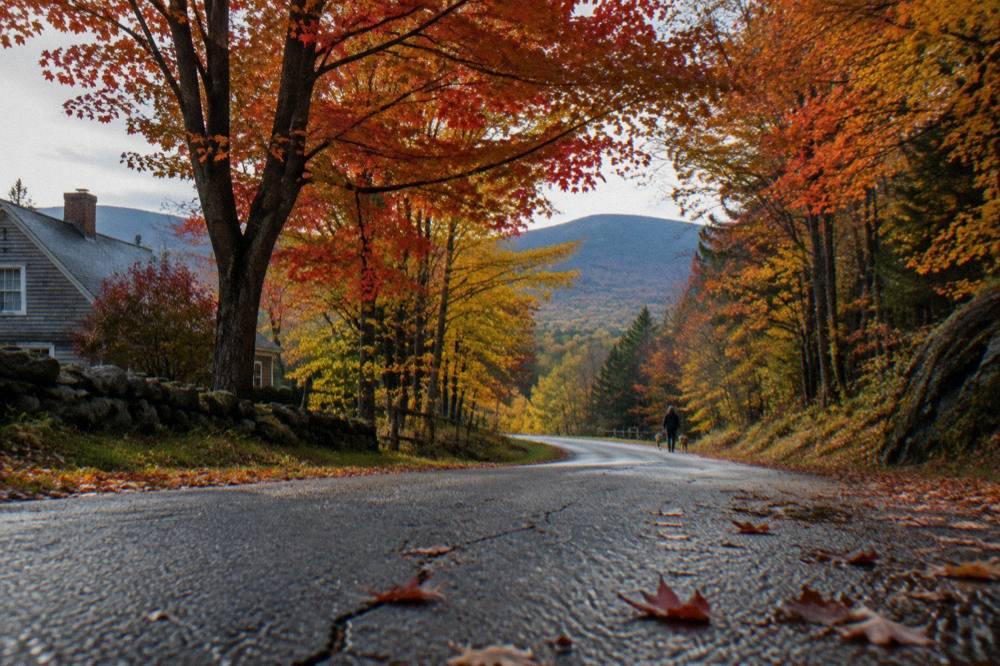
Peak foliage for a Vermont bike tour falls between late September and mid October, and the exact week depends on where in the state you point the wheels. The Northeast Kingdom, the highest and northernmost riding country, peaks first, usually in the final days of September. Central Green Mountain valleys follow in the first days of October, and the southern counties around Manchester and Woodstock hold color into mid October before the leaves drop. If you want help matching those windows to a specific ride, our month by month guide to Vermont foliage timing lines up the color shifts with sample routes.
Riders chasing the sharpest color should think in terms of a descending route rather than a fixed date. Start high and north, in the hills around East Burke or the upper Lamoille Valley, then work south and lower as the week goes on. The typical statewide peak window runs about the first nine days of October, centered on the first weekend, but that single number hides a lot of useful spread: the same week that leaves a Kingdom ridgeline past peak can put a Windham County valley at its absolute best.
The other timing variable is weather within the window. A wet, windy storm can strip a region early, and a calm stretch of cool nights and sunny days can hold color longer than the averages suggest. Vermont foresters publish weekly foliage reports through the season, and serious leaf riders check them the way skiers check snow reports. Build one flexible day into any itinerary so you can shift a ride a county north or south based on the latest report.
Daylight deserves a line in the plan, not just the color. In early to mid October the sun rises near 7:00 and sets near 6:20 in Vermont, which trims the rideable day considerably compared with summer. That is plenty for a forty mile road loop or a morning at Kingdom Trails, but it means long itineraries should start early and build in a hard turnaround time, because dusk arrives quickly under a mountain horizon.
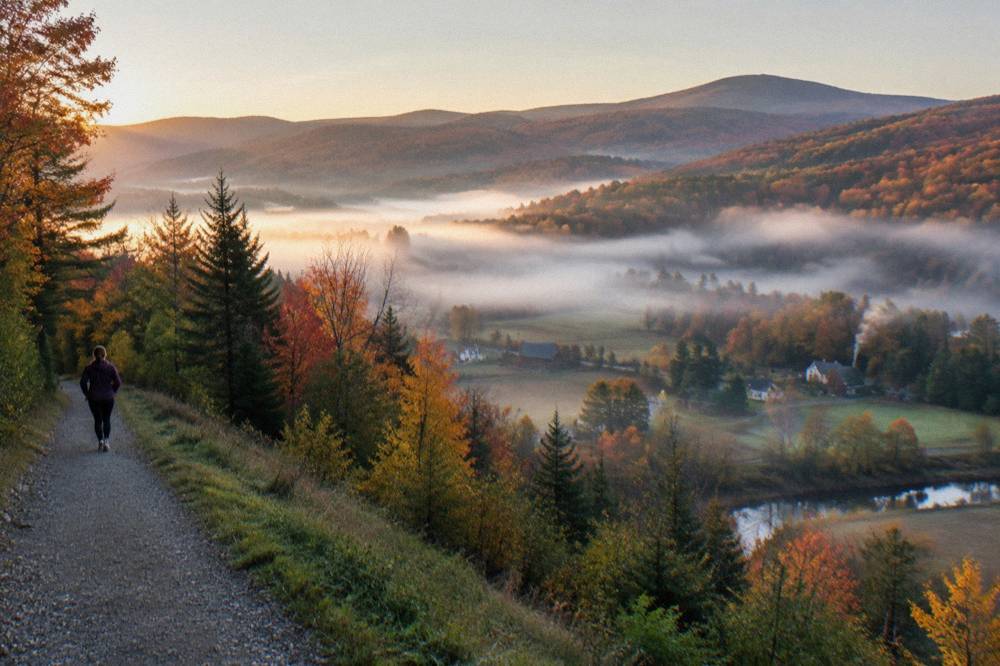
The Northeast Kingdom peaks first, typically in late September to the first days of October, because it combines the state's highest average elevations with its northern position. Central Vermont, the Green Mountain and Lamoille County country, follows in the first week of October. Southern Vermont, the Bennington and Windham county valleys, peaks last, around mid October, and low river valleys everywhere run behind the ridgelines above them by a week or more.
The practical version of that gradient is a table. Riders planning a multi-day trip can read it as a sequencing tool: match your riding days to the regions in the order they turn.
| Region | Typical peak window | Riding character | Best base towns |
|---|---|---|---|
| Northeast Kingdom (Orleans, Essex, Caledonia counties) | Late September to early October | Mountain bike singletrack at Kingdom Trails, quiet lake country roads | East Burke, Lyndonville |
| Central Green Mountains and Lamoille Valley | Early October | Rail trail touring on the LVRT, Stowe Recreation Path, mountain road climbs | Stowe, Jeffersonville, Morrisville |
| Champlain Valley and Burlington | Early to mid October | Waterfront bike path, Island Line riding, causeway views | Burlington, Colchester |
| Southern Vermont (Woodstock, Manchester, Windham County) | Mid October | Village gravel loops, carriage roads, resort road riding | Woodstock, Manchester |
Two nuances sharpen the table. First, elevation works within regions too: a Route 100 ridgeline will be past prime while the valley floor a few hundred feet below is still turning, so a loop that climbs and descends passes through several stages of color in one ride. Second, the sugar maple stands that produce the loudest reds concentrate in certain valleys, and local riders know which hollows fire earliest. Ask at a bike shop in whatever town you base from, because shop staff ride these roads daily and will point you at the stand that is peaking that week.
The Kingdom deserves special mention for a foliage trip, because its color and its trails arrive together. The network around East Burke holds over one hundred miles of non-motorized singletrack and multi-use trail across more than two hundred named routes, and its summer riding season runs from when conditions allow, typically May, to about the end of October. A late September or early October morning there can put you in peak color on flowy singletrack with almost nobody else on the hill, since the summer bike crowds thin exactly when the leaves turn. Check the Kingdom Trails Association site for the current trail status and pass purchasing before you go, because the network requires a pass and conditions close trails after rain.
The best foliage routes pair color density with rideable surface: the Lamoille Valley Rail Trail for a 95 mile car-free tour through northern hardwood forest, the Kingdom Trails singletrack at East Burke for color at mountain bike speed, the Stowe Recreation Path for an easy village ride under maples, and the quiet gravel loops around Woodstock and the Mount Tom carriage roads for southern Vermont's late color.
Each of those earns its place for a different kind of rider, and the table below breaks down how they compare for a leaf-season trip. Distances are the full trail figures; most riders sample a section rather than ride end to end.
| Route | Type | Length | Why it works in foliage season |
|---|---|---|---|
| Lamoille Valley Rail Trail | Rail trail, compacted stone | 95 miles, St. Johnsbury to Swanton | New England's longest rail trail, linking 18 towns through continuous hardwood color, under 3 percent grade |
| Kingdom Trails, East Burke | Mountain bike singletrack and multi-use | 100+ miles of trail | Peak color arrives here first, late September, on flowy forest riding |
| Island Line Trail, Burlington | Paved path and gravel causeway | About 14.4 miles to South Hero | Lake and mountain views with valley color, about 8 paved miles plus a 5 mile gravel causeway |
| Stowe Recreation Path | Paved village path | Village length, links to road loops | Easy family riding under maple canopy, direct from Stowe lodging |
| Woodstock gravel loops and Mount Tom carriage roads | Gravel roads, carriage roads | Various loop lengths | Southern Vermont color at its mid October peak, very light traffic |
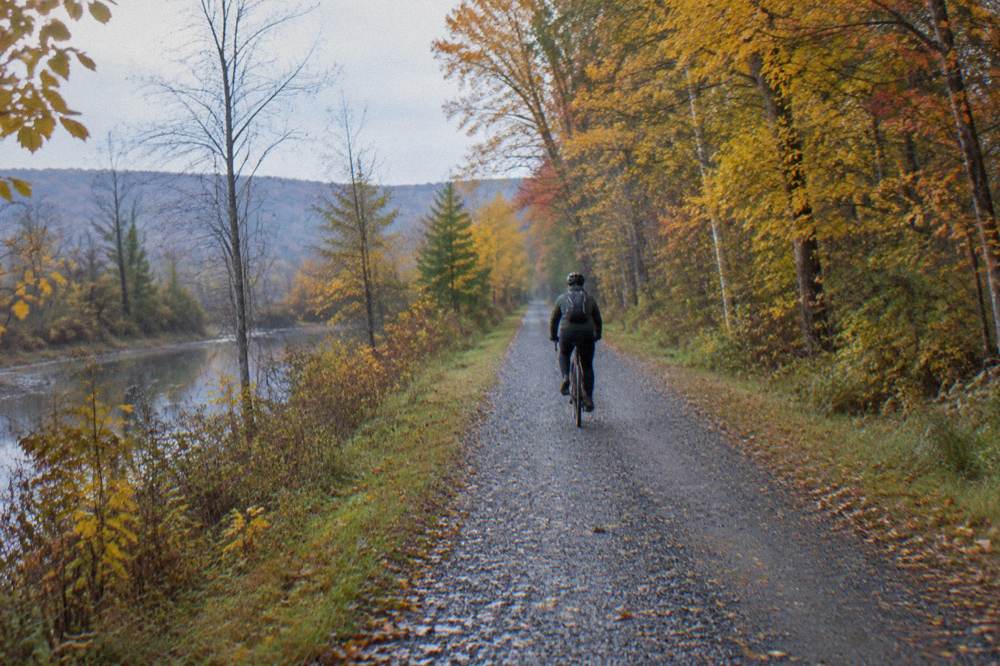
The Lamoille Valley Rail Trail is the foliage workhorse. It runs firm, compacted crushed stone about ten feet wide with grass shoulders, holds grades under three percent, and passes through eighteen towns between St. Johnsbury and Swanton, which means a rider can string together inn stays, delis, and breweries without ever sharing a lane with a car. E-bikes are allowed on the trail, and all non-motorized uses are welcome year-round; motorbikes and scooters are not. Because it is a long trail with seasonal maintenance, check the state rail trails page for status before committing to a long segment.
Down in Burlington, the Island Line Trail gives foliage a different frame: about fourteen and a half miles from the waterfront to South Hero, with an eight mile paved greenway segment and a five mile crushed gravel causeway across the lake. One note for planners: the Local Motion bike ferry that carries riders across the causeway gap runs seasonally, late May to mid October, and is closed for the current season, returning in May. The ferry page carries the operating details, so anyone hoping to ride the full line to the islands should confirm the schedule before building an itinerary around it.
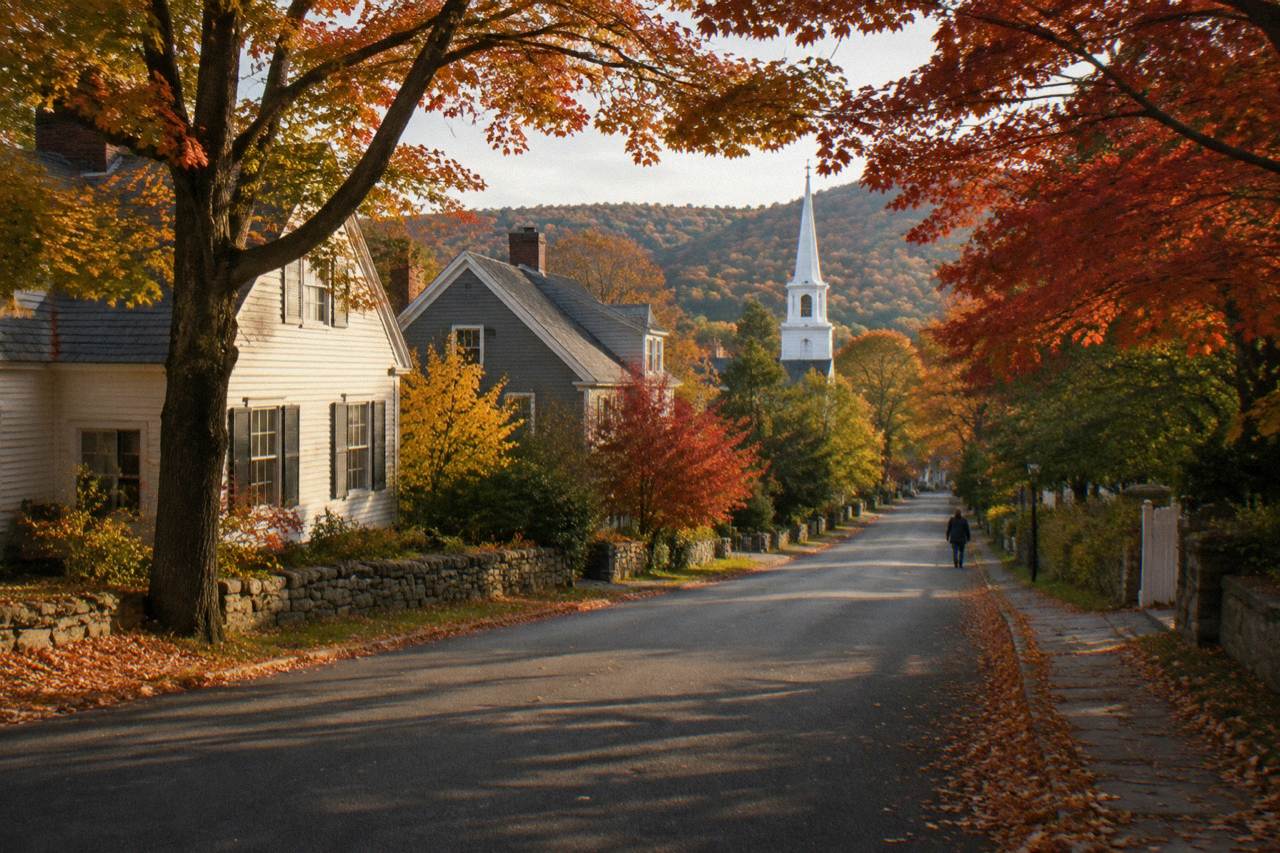
Southern Vermont riders get the last and often overlooked act. While the national attention has moved on by then, the Woodstock area in mid October delivers village streets under full color and gravel loops with almost no traffic, and Manchester anchors resort road riding in the southern hills. For a fuller treatment of the timing question region by region, our guide to Vermont foliage peak dates by region breaks the state into finer slices.
Leaf-season traffic is real but concentrated: the marquee scenic corridors, Route 100 above all, carry heavy weekend sightseeing traffic through the peak window, while the secondary backroads a mile away stay quiet, and midweek riding is calm almost everywhere. Narrow shoulders are the standard condition on rural Vermont roads, so route choice matters more in October than in July.
The pattern is predictable enough to plan around. Day-trippers concentrate on a handful of famous roads on Saturday and Sunday afternoons, and the same hairpin overlook that is a parking problem at 2 pm on a Saturday can be empty at 9 am on a Tuesday. Riders planning road mileage should build loops on the town highways that parallel the scenic arteries, which carry the same color with a fraction of the cars, and should favor morning start times in the popular corridors.
The infrastructure reality is that many Vermont country roads are narrow with limited or no shoulder, and state law asks cyclists to ride as far right as is safe. That is workable on a low-traffic gravel or paved town road and unpleasant on a sightseeing artery, which is another argument for the rail trails and path networks in peak leaf weeks. Riders who want a deeper comparison of surfaces should read our piece on road versus gravel versus e-bike riding in Vermont, which works through the tradeoffs.
Weather compounds the traffic question in one specific way: wet leaves on pavement. A rainstorm followed by cool weather leaves slick patches on shaded corners and on rail trail stone, and leaf litter hides potholes and gravel. Brake earlier than you would in summer, hold your line through drifts of leaves rather than steering through them mid-corner, and treat any shaded descent as if the corner were painted. Riders report that these conditions, not traffic, are the most common cause of leaf-season spills.
Pack for a thirty degree temperature swing and a ride that ends in the dark: full finger gloves, a warm head layer, a wind shell, lights front and rear, and layers you can shed as the morning chill burns off. October averages run near a high of 56 and a low of 36, so the first hour usually starts near freezing and the midday hours are close to ideal riding temperature.
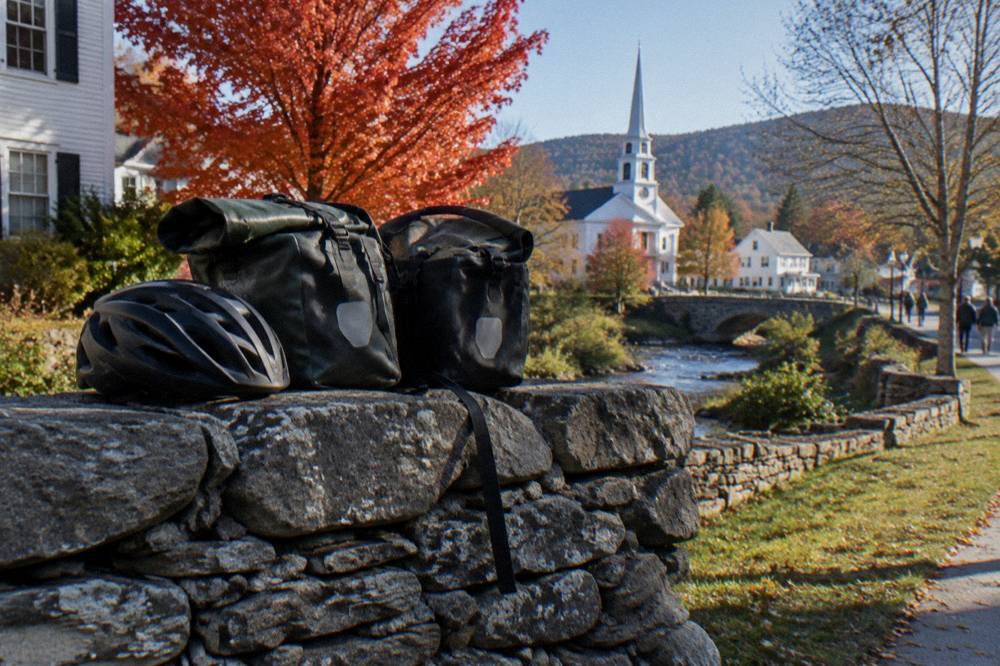
The layering logic is straightforward. Start warm and strip down: a thermal base layer, arm and knee or full leg warmers, a wind vest or shell, and a jersey underneath. Stuff the shed layers into pockets or a frame bag, because the same temperature that feels perfect at noon drops fast after 4 pm and the last hour home can be genuinely cold if you are still out. Full finger gloves matter more than most riders expect, both for warmth and for the damp handlebar grip that comes with morning condensation. More of these guides are collected on Vermont Biking Tours.
| Packing category | What to bring | Why in October |
|---|---|---|
| Layers | Thermal base, warmers, wind shell, spare jersey | High near 56, low near 36, warm midday, cold starts and finishes |
| Light and visibility | Front and rear lights, reflective details | Sunset near 6:20, shaded valleys go dark earlier |
| Wet conditions | Fenders or a rear splash guard, brake check | Wet leaves on pavement and trail, slick shaded corners |
| Navigation | Downloaded route, paper backup | Cell coverage is patchy in the Kingdom and the hills |
| Trail specifics | Pass purchased in advance, tire choice for gravel or singletrack | Kingdom Trails requires a pass; rail trail stone favors wider tires |
Two Vermont-specific additions to the list. First, if Kingdom Trails is on the itinerary, buy passes in advance through the Kingdom Trails Association store or plan a stop at the Welcome Center on Route 114 in East Burke, and check the trail map for any landowner-specific closures or e-bike exclusions. Second, carry a real repair kit on the rail trails: the LVRT passes through towns regularly, but the spacing between services is enough that a flat plus dropping temperatures becomes a genuine problem if you have no tube or pump. Our fuller rundown is in what to bring on a Vermont bike tour.

Match the lodging to the riding, not to a scenic drive: East Burke or Lyndonville for Kingdom Trails color, Stowe for the Recreation Path and mountain road loops, Woodstock for mid October gravel and carriage roads, and Burlington for waterfront path riding. Book early, because foliage weekends fill Vermont's small inns weeks ahead, and the best located properties go first.
The distance from bed to trailhead is the variable that quietly decides whether a foliage trip works. A property that sits on or beside the riding means dawn starts, no parking hassle at crowded trailheads, and the option to roll home for layers when the weather turns. That is worth more in October than any other month, because the riding window is short and the popular parking areas fill on peak weekends.
In the Kingdom, The Wildflower Inn in Lyndonville is built for exactly this: it sits 2.3 miles from Kingdom Trails, offers bike rentals and a bicycle shuttle, which removes the trailer-and-roof-rack question entirely. Down in the Stowe cluster, Sun & Ski Inn And Suites in Stowe puts the Stowe Recreation Path and the village road loops at the door. In the south, Woodstock Inn & Resort in the village of Woodstock anchors the gravel loops and the Mount Tom carriage roads that hold color latest of all.
Woodstock village
The village base for the Woodstock gravel loops and the Mount Tom carriage roads.
Check ratesLodging strategy also shapes the daily rhythm. Staying in the same town three or four nights beats a nightly hotel shuffle, because you learn the local roads, the breakfast that opens early, and the shop that can true a wheel. Vermont's riding towns are close enough together that a single well-chosen base covers a lot of ground: from Stowe you can reach the LVRT, from Lyndonville you are inside the Kingdom, from Woodstock you cover the center-south.
Lyndonville, 2.3 miles to Kingdom Trails
Offers bike rentals and a bicycle shuttle, and sits 2.3 miles from Kingdom Trails.
Check ratesYes, and foliage season is one of the best times for both. E-bikes are allowed on the Lamoille Valley Rail Trail and on the Burlington Greenway and Island Line corridor, where Class 1 pedal assist is permitted and throttle motorcycles are not. At Kingdom Trails, Class 1 pedal assist eMTBs are allowed on most trails per the Kingdom Trails Association, with the trail map showing landowner exclusions.
The state's land rules are the one place to be careful. On Vermont state land, e-bikes are currently prohibited on non-motorized natural surface trails and allowed on roads and multi-use paths, and the Vermont Mountain Bike Association publishes the current policy. Kingdom Trails is largely private land with its own rules, which is why it can welcome Class 1 pedal assist where a state forest next door cannot. The practical summary for a leaf-season visitor: rail trails and paved paths, yes everywhere; mountain bike singletrack, only where the managing body says so, and at Kingdom Trails that means Class 1.
E-bikes also change the foliage math for mixed groups. A rail trail like the LVRT, with grades under three percent, is already forgiving, and a Class 1 rental lets a rider of uneven fitness hold the same daily distance as the group's strongest rider. In Burlington, Local Motion's Trailside Center at 1 Steele Street rents conventional, Class 1 e-bike, adaptive, and kids bikes right on the path, with reservations recommended in busy weeks. The fuller rules picture is in our guide to Vermont e-bike and helmet rules.
Vermont's bike tour operators run their full season calendars straight through the foliage window, because October is the state's signature draw. VBT Bicycling Vacations, Great Bike Tours, Lamoille Valley Bike Tours, and Vermont Mountain Bike Tours all operate in the state, and readers book with the operator directly; this site sells and books nothing and carries no operator pricing.
The operator market splits into formats. VBT Bicycling Vacations, the long established VBT, runs guided and self guided inn to inn trips with luggage transport, which in foliage season means riding between small towns while your bags travel ahead. Smaller regional outfits like Lamoille Valley Bike Tours and Vermont Mountain Bike Tours work closer to home ground, with day rides and local guiding. Great Bike Tours rounds out the multi day options. For support and skills, Local Motion operates the Trailside Center in Burlington as a nonprofit base for path riding and rentals.
What a foliage departure typically includes, across the guided market, is lodging, luggage transfer between inns, route materials, some meals, and a sweep or support presence on the road. What it never includes is a guarantee of peak color on your exact dates, because nobody can promise that. Operators schedule their leaf departures around the regional averages in the table above, and a good question to ask any of them is what their route does if the color has moved. The strongest answers involve flexibility: a route that crosses elevation bands, or a base town with riding options in several directions. Our guide to choosing a Vermont bike tour lists the questions worth asking before you commit. If pedaling isn't the only way you want to chase the leaves, the comparison of Vermont foliage tours by bike, bus and train lays out the alternatives with routes and operators.
Self guided riders should not overlook the operator-free version, which is what most Vermont locals do: book an inn on or near a trail, ride loops or point to point segments with a shuttle or a willing driver, and let the foliage reports decide the direction each morning. The rail trails make this almost foolproof, because the surface is consistent, the towns are frequent, and the grade never bites.
A foliage bike trip costs what lodging, bike rental or transport, passes, and food cost, and those stack differently by format: a self guided rail trail trip built on one inn is the budget end, a multi day guided inn to inn trip is the premium end, and the swing between them is mostly the guided package. No operator or rental prices are printed here because none are verified; treat every figure below as a planning frame, not a quote.
The honest way to budget is by category, with the volatile items flagged as things to check at the source. Lodging is the largest line and the most season sensitive, because foliage weekends carry the state's highest demand. Passes and trail access are the smallest line: Kingdom Trails requires a pass, and current pricing lives on the Kingdom Trails Association store rather than in any secondhand article, ours included.
| Cost category | What drives it in foliage season | Where the real number lives |
|---|---|---|
| Lodging | Peak weekend demand, location relative to riding | The property's own listing |
| Bike or e-bike rental | Type of bike, multi day versus single day | The shop's own pricing page |
| Trail passes | Kingdom Trails access, day versus season | Kingdom Trails Association store |
| Guided trip package | Lodging, luggage transport, meals, guiding included | The operator's own site |
| Getting there and around | Car travel between regions, or a single base town | Route planning |
One structural way to cut cost is to compress the geography. A single base town with riding in three directions replaces the driving that a move-every-night trip requires, and midweek nights run quieter and cheaper than peak weekends everywhere in the state. Another is timing the shoulder: the week after the statewide peak still holds strong color in the southern valleys, with thinner crowds and easier bookings. For the broader market picture, see how Vermont bike tour prices work, which explains what guided packages bundle and why the formats differ so much.
Finally, put a small buffer in the budget for the things October actually throws at riders: a cafe stop that becomes lunch when the rain arrives, a shuttle when a knee decides the day is over, a spare pair of gloves. The cheap version of a foliage trip is a motel, a rail trail, and a deli; the expensive version is a resort, a guided itinerary, and dinners out. Both see the same trees.
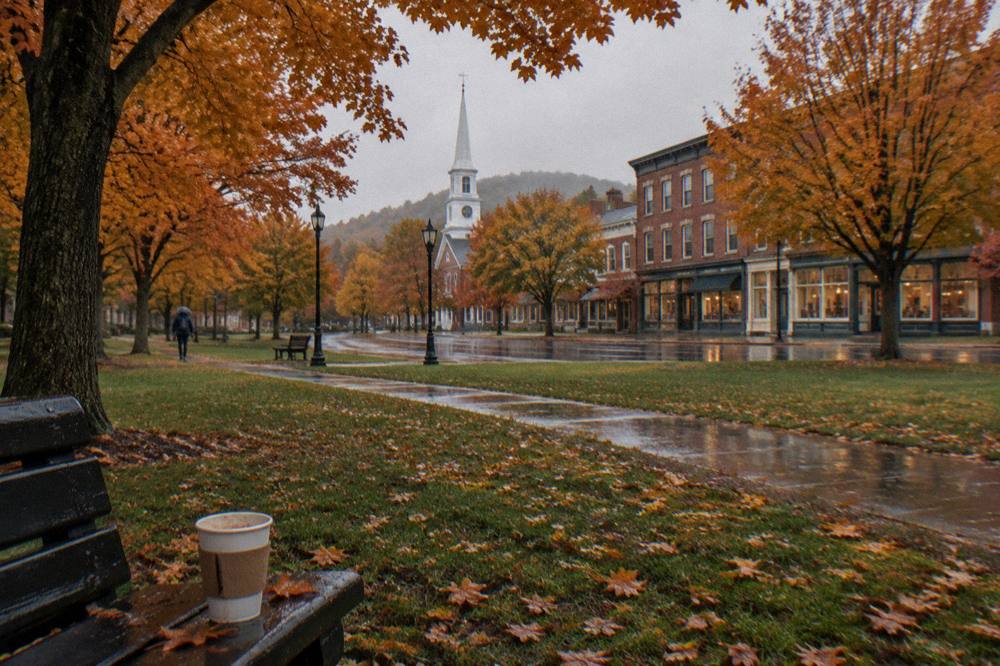
Between late September and mid October. The Northeast Kingdom peaks first in late September, central Vermont in the first week of October, and the southern valleys around mid October. The typical statewide peak window is roughly the first nine days of October, with ridgelines ten to fourteen days ahead of valleys.
Not in southern Vermont. The Bennington and Windham county valleys and the Woodstock area often hold strong color into mid October, and crowds thin after the statewide peak. Northern and high elevation areas are usually past prime by then.
Yes. The summer season runs from when conditions allow, typically May, to about the end of October, so peak leaf color overlaps the riding season. A pass is required, bought online through the Kingdom Trails Association store or at the Welcome Center in East Burke, and riders should check trail status after rain.
On the rail trails and paved paths, yes: the Lamoille Valley Rail Trail allows e-bikes, and the Burlington corridor permits Class 1 pedal assist. At Kingdom Trails, Class 1 pedal assist eMTBs are allowed on most trails per the Kingdom Trails Association, with exclusions shown on the trail map. State land natural surface trails generally do not allow e-bikes.
The ferry runs seasonally, late May to mid October, and is closed for the current season, returning in May. Riders planning the full Island Line crossing to the Champlain Islands should confirm the schedule on the operator's ferry page before building an itinerary around it.
Layers for a thirty degree swing: October averages run near a high of 56 and a low of 36, so start with a thermal base, warmers, a wind shell, and full finger gloves, and be off the road or lit up well before sunset near 6:20.
Before you go, the pick for this guide:
The Wildflower Inn
Offers bike rentals and a bicycle shuttle, and sits 2.3 miles from Kingdom Trails.
Check rates →