The Wildflower Inn
Lyndonville, 2.3 miles to Kingdom Trails
Offers bike rentals and a bicycle shuttle, and sits 2.3 miles from Kingdom Trails.
Check ratesVermont does not have one foliage season. It has three or four running in sequence, and the difference between the northern hills and the southern valleys is more than a week of color. Here is how the peak windows shift across the state, and how riders use that shift.
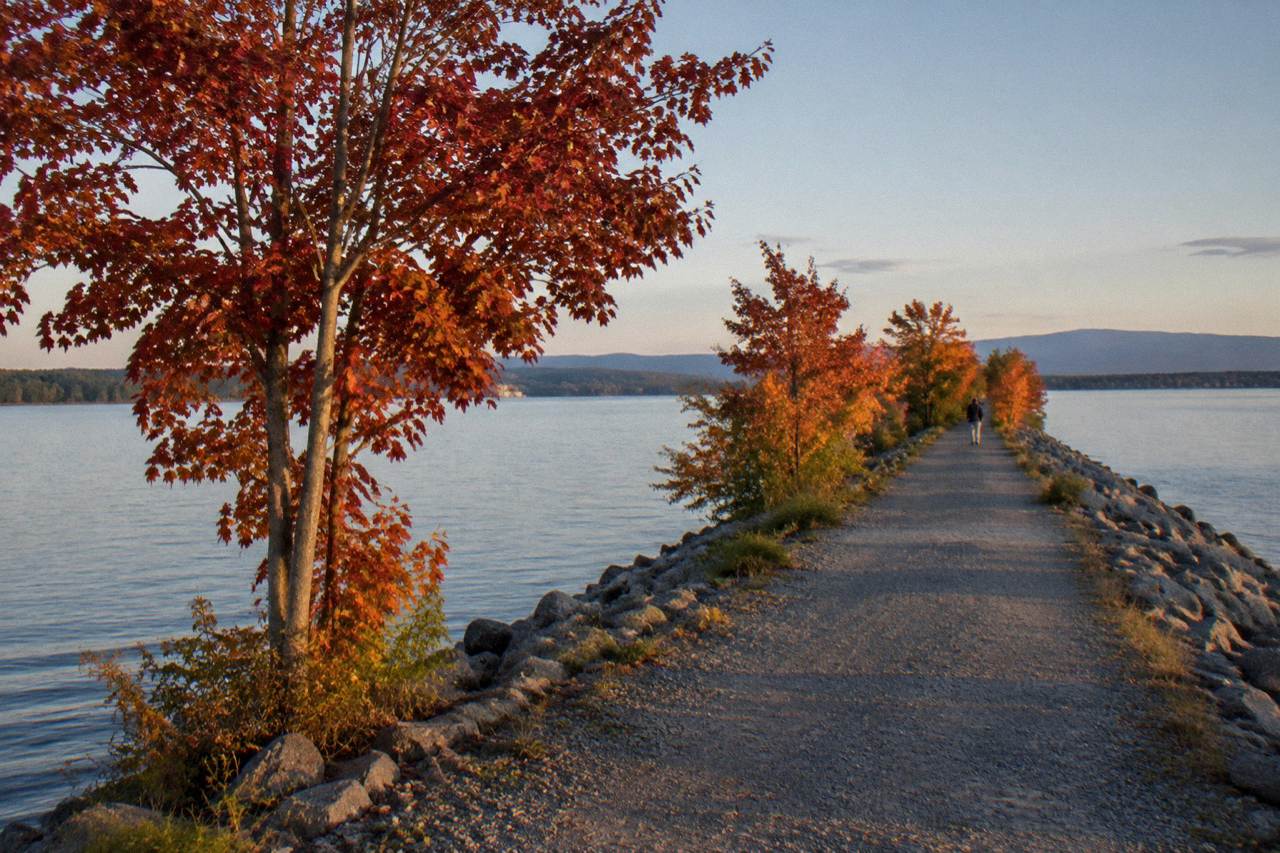
Short answer
Typical statewide peak runs about the first week and a half of October, roughly October 1 to 9. The northern Northeast Kingdom colors first, in late September to early October. Central Vermont follows in early October, and southern valleys peak toward mid October. Ridgelines run one to two weeks ahead of the valleys below them.
Vermont's color does not arrive all at once. The maple ridges of the Northeast Kingdom turn while the southern valleys are still green, and the gap between them runs a week or more. Riders who understand that sequencing can chase good color for nearly three weeks simply by moving south, and the same ride that is past peak near Burke can still be at peak near Bennington. This guide lays out the typical peak windows region by region, explains the elevation effect that drives them, and connects the timing to the practical questions of planning a fall bike trip: where to ride, where to stay, and what October conditions actually feel like from the saddle. If you want a home base rather than a moving tour, the town-by-town guide to Vermont's best foliage towns for riders pairs each ride with its peak window and lodging options.
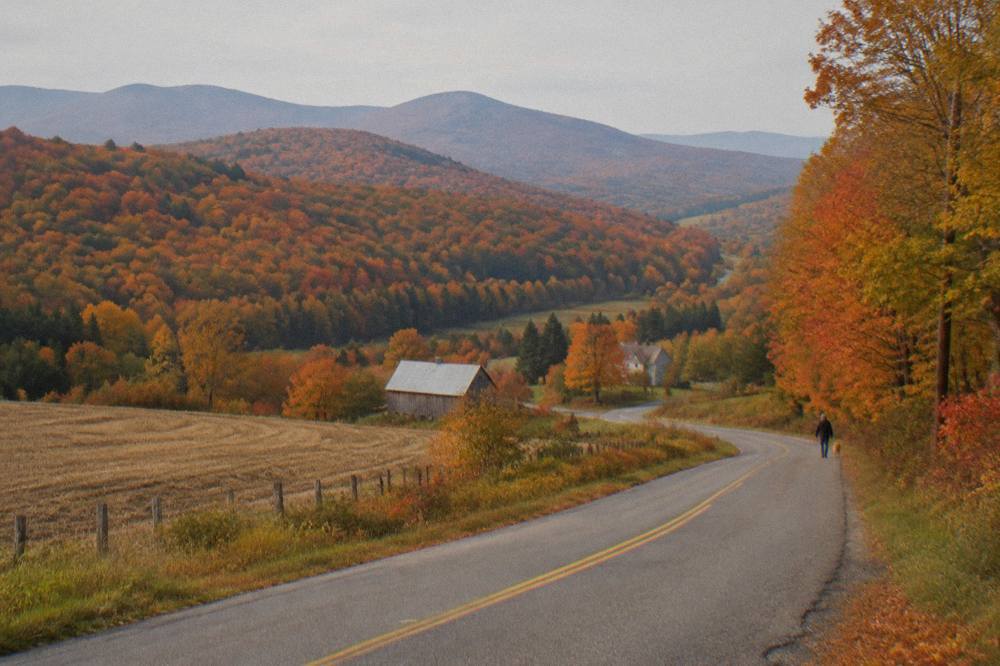
The typical statewide peak window runs from about October 1 to October 9, centered near the first weekend of the month. Northern regions reach that peak first, in late September to early October, while southern valleys hold on until mid October. That means a rider who times a trip around the statewide center can usually find strong color somewhere within a short drive in either direction.
That statewide window is an average of regions that behave quite differently. The northern Northeast Kingdom, the highest and coldest part of the state, turns first: its typical peak lands in late September to early October. Central Vermont, the Green Mountains and the Lamoille and Washington county country, follows in early October. The southern counties, Windham and Bennington, peak around mid October in the valleys. Fold all of that together and you get the familiar first-week-of-October average, which is real but which hides more than it reveals for anyone planning a bike trip.
The practical takeaway for cyclists is that foliage season is longer than the peak. Color builds for two weeks before peak and holds for a week or more after it, and a past-peak hillside in bright sun is still a fine place to ride. Riders tracking a map for fall foliage should treat the peak date as the center of a planning window, not a single day to hit.
| Region | Typical peak window | Character of the color |
|---|---|---|
| Northeast Kingdom (Orleans, Essex, Caledonia counties) | Late September to early October | Earliest and often the most intense, high maple and birch country |
| Central Vermont (Green Mountains, Lamoille, Washington) | Early October | The classic postcard window, sugar maples on rolling terrain |
| Champlain Valley and Burlington area | Early to mid October | Lake-moderated, turns slightly after the hills above it |
| Southern Vermont (Windham, Bennington) | Mid October | Latest valleys, color lingering after the north has dropped |
Two things drive the stagger: day length and cold. Day length shortens everywhere at the same rate, which starts the process, but cold nights decide the pace, and cold arrives earlier at higher elevations and farther north. The Northeast Kingdom sits higher and colder than the southern valleys, so its maples shut down chlorophyll production first and its ridgelines run ten to fourteen days ahead of the valleys below them.
Elevation is the sharper of the two levers. The same mountain can hold green at its base and full red two thousand feet up its flanks, which is why riders climbing out of a valley on a fall morning sometimes pass through two stages of the season in a single ascent. Ridges in the north can effectively finish their season while south-facing, low-lying fields are still waiting for their turn. This is why foliage maps drawn by region are only an approximation: within any one region, the dates smear across a range of altitudes and aspects.
Latitude adds the second offset. The Northeast Kingdom is both the highest part of the state and its northeastern corner, so it gets the earliest frost pattern and the shortest effective growing tail-end. Southern Vermont sits lower and closer to the milder southern New England influence, and its valleys are consistently the last places in the state to turn. The stagger between the Kingdom's peak and the southern valleys' peak is commonly about a week, sometimes more in a slow-cooling year.
Weather within the season modulates all of it. A wet late summer and early fall tends to produce stronger, more vibrant color than a drought-stressed one, and an early hard frost or a windy storm can cut a region's display short regardless of the calendar. That year-to-year variance is why no peak-date map should be trusted to the day: it is a planning instrument, and live conditions reports are the confirmation.
The Northeast Kingdom, the Orleans, Essex and Caledonia county country in the state's northeast corner, typically peaks from late September to early October, the earliest window in Vermont. Its higher terrain can reach peak a few days before the valleys around it, and the display is largely past by the second week of October. Riders targeting this region should plan for the last days of September or the first days of the month that follows.
The Kingdom is also the state's signature mountain biking destination, which makes its early window doubly useful. Kingdom Trails in East Burke manages more than 100 miles of non-motorized singletrack and multi-use trail across some of the highest maple and birch country in Vermont, and riding through that forest at peak is a well-known fall pairing. The trail network runs when conditions allow, typically from May through the end of October, then closes for late-autumn deer hunting before the winter fat-bike network opens. Passes are bought online through the Kingdom Trails Association store or at the Welcome Center on Route 114 in East Burke, and current pass prices are listed there rather than anywhere on this site. To fit a ride like that into a longer leaf-peeping trip, the three-day Vermont fall itinerary with a bike day built in shows how to sequence the timing.
Timing a Kingdom ride means watching two things at once: the foliage reports and the trail conditions. The association publishes a conditions page that links to live trail status, and a wet early-October week can close soft singletrack even when the color is perfect. The shops around East Burke, including East Burke Sports, Kingdom Bike Rentals, Village Sport Shop and Rifugio Darling Hill, all rent bikes through the season; rental prices are set by each shop and change, so ask directly.
For a stay, The Wildflower Inn sits 2.3 miles from the Kingdom Trails network in Lyndonville, offers bike rentals and a bicycle shuttle, and works as a single base for a multi-day foliage trip at the early end of the state's season. The Wildflower Inn in Lyndonville is the lodging option listed closest to the trails themselves.
Lyndonville, 2.3 miles to Kingdom Trails
Offers bike rentals and a bicycle shuttle, and sits 2.3 miles from Kingdom Trails.
Check rates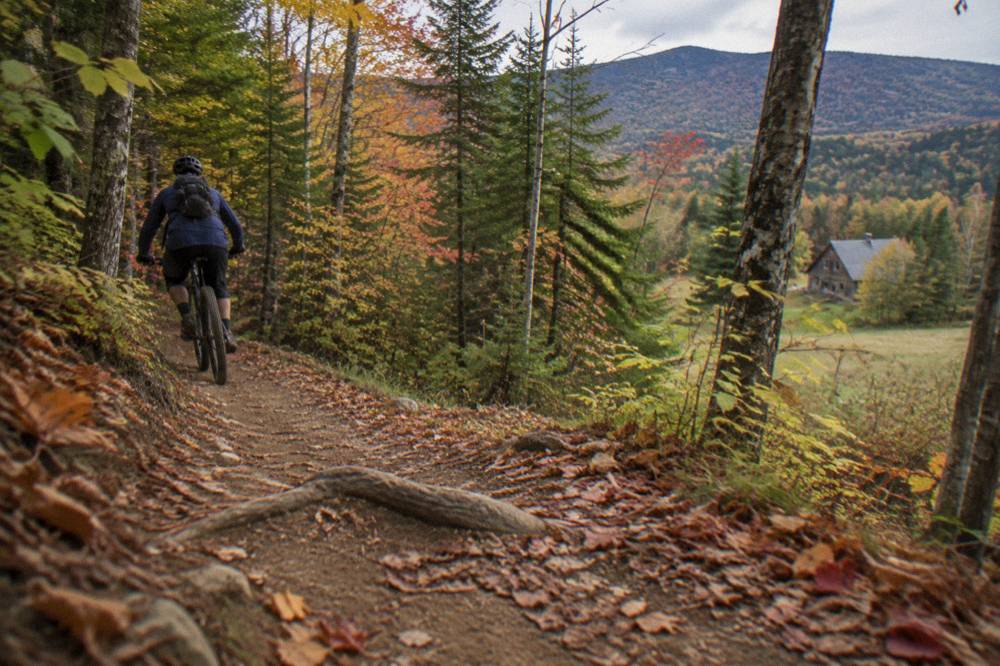
The Kingdom's early window has one more consequence worth planning around: it is also the first region to go past peak. A mid-October trip aimed at Burke will find bare ridgelines and leaf-covered trails, which some riders genuinely prefer for grip and quiet, but anyone chasing peak color there has to arrive with September. The state's foliage progress reports track the region week by week through the season, and the northern hills are usually described as past peak by the second week of October while color holds in the south.
Central Vermont, the Green Mountain spine and the Lamoille and Washington county country around it, typically peaks in early October, with the strongest color in roughly the first ten days of the month. Valleys like the Champlain lowlands and the town greens turn a few days after the hills above them. This is the window most postcard photographers and most foliage bike trips aim for.
Central Vermont is also where two of the state's signature rides sit. The Lamoille Valley Rail Trail runs 95 miles from St. Johnsbury west to Swanton through 18 towns, and the state's rail trail program describes it as the longest rail trail in New England, open year-round to non-motorized uses with e-bikes allowed. A fall ride along it passes working farmland and river valley hardwoods rather than high ridges, so its color runs with the valley calendar: early October, holding slightly longer than the Kingdom's hills. The Lamoille country also connects to the Stowe area, where the Stowe Recreation Path and the road loops around the village give riders a car-free spine plus quiet road options, all inside the same early-October window. If you'd rather base yourself somewhere with rides right out the door, the best Vermont foliage towns for a riding trip lays out the strongest home bases.
Burlington and the Champlain Valley deserve their own note inside the central window. Lake Champlain moderates the lakeshore, so the city's trees and the Burlington Bike Path's corridor of color tend to turn a touch after the hills east of the city. The Island Line Trail runs about 14.4 miles from the Burlington waterfront toward South Hero, roughly 8 miles paved as the Greenway and about 5 miles of crushed gravel on the Colchester Causeway, and a lakeside foliage ride there in the second week of October often catches valley color at its height with the Adirondacks red across the water.
Riders planning a central-Vermont stay have the deepest hotel bench of any region. Sun & Ski Inn And Suites in Stowe is listed as a base for the Stowe Recreation Path and the village road loops, and the other Stowe and Burlington stays shown below sit similarly close to rideable corridors. More on the full lodging picture sits in the stay section below.
Southern Vermont, the Windham and Bennington county country, typically peaks around mid October, the latest window in the state, with the low valleys holding color after everything north of them has dropped. Riders who arrive late in the foliage season should aim here. The region's lower elevations and gentler terrain stretch the display out, and strong color can linger well past the date the northern hills are bare.
The south rewards a different kind of riding. Manchester and Woodstock sit among gravel and paved backroads that roll through lower, warmer valley country, and the Woodstock area in particular is known among cyclists for its gravel loops and the carriage roads on Mount Tom, a mellow dirt surface that peaks with the surrounding hardwoods. The Equinox in Manchester is a resort base for southern Vermont road rides, positioned for the routes that climb out of the valley toward the ridge roads, where the elevation effect means the tops of the climbs color ahead of the valley floors by a week or more.
A southern trip also pairs well with a late ferry-free ride on the Champlain shore, since the valley color along the lake runs nearly as late. But the core southern play is simple: when the state's foliage reports start describing the north as past peak, the Windham and Bennington valleys are usually at or just approaching their best, and a bike trip planned for that week gets peak conditions with thinner crowds than the first-week rush.
| If your trip week is... | Ride here | Why |
|---|---|---|
| Late September | Northeast Kingdom singletrack and backroads | The Kingdom peaks first; everything else is still green |
| First week of October | Central Vermont, Stowe, Lamoille Valley Rail Trail | The statewide peak center, postcard color on valley rides |
| Second week of October | Champlain Valley, Burlington, Island Line Trail | Lake-moderated valley color runs late; the causeway is gravel but firm |
| Mid October and later | Southern Vermont, Woodstock, Manchester roads | The last valleys to peak, color holding after the north drops |
Ridgelines in Vermont typically run ten to fourteen days ahead of the valleys below them, a wider spread than most regional maps show. A single mountain can hold green at its base and full red partway up, and a ride that climbs a few hundred feet effectively moves the season forward. For cyclists this means elevation is a timing tool: ride high early in the season, ride low late.
That spread has real route consequences. A gravel loop out of Woodstock that climbs toward the Mount Tom uplands will meet color a week or more before the village streets do. The climbs out of the Champlain Valley toward the Green Mountain foothills work the same way. Riders who want to stretch a short trip across the whole color arc can literally ride different weeks of the season in one morning by choosing how much vertical their route includes, and the descents hand the color back on the way down. The wider set of guides lives on Vermont Biking Tours.
The effect also explains a common traveler confusion: two people can ride the same region on the same day, one on a ridge road and one on a valley rail trail, and report the foliage as peak and as green respectively. Both are right. The Vermont foliage reports track this at the regional level, and the most useful reading of any report is which elevation band it is describing, not just which county. Reports tend to describe the northern high country first, then the mid-elevation hills, then the southern and lakeside valleys, in that order, week after week.
For ride planning, a simple rule covers most of it. Early in the window, prioritize routes with climbing and northern exposure, where the cold has already done its work. Late in the window, drop into the valleys and head south, where the moderated air holds the leaves. In between, the mid-slope country around Stowe, the Lamoille Valley and the Mad River valley is usually the safest bet for full color.

Pick the region to match the week, then the route to match the elevation: the Kingdom for late September, central Vermont for the first week of October, the Champlain Valley for the second week, and the southern valleys for mid October and after. Confirm with the state's weekly foliage progress report and the local trail conditions page before committing, since weather can move the peak by several days in either direction.
The sequencing trick is the part most visitors miss. Because the regions stagger by a week or more, a rider with flexible dates does not need to gamble on a single peak date. Arrive in the north at the start of its window, and if the color is early or late, drive an hour south or north to re-enter it. A trip based in one town for a week will usually see the peak arrive or depart within that week somewhere within riding distance, which is why many foliage riders base somewhere central, like the Lamoille Valley or Stowe, and radiate.
Trail-based riders should layer a second check on top of the foliage report. Singletrack, especially the Kingdom's, closes or softens with rain, and the associations that manage these networks publish live status. The rail trails are more forgiving: the Lamoille Valley Rail Trail's compacted stone surface drains well and carries fall riders straight through the season, and the state's rail trail pages post updates when a trailhead or segment needs a detour. Check trail status before a long ride regardless of the surface, the managers themselves say so.
One timing note specific to the Champlain crossings: the Local Motion bike ferry across the causeway gap runs a seasonal service described as late May to mid October, and it is closed for the current season outside that window. Riders hoping to ride the full Island Line out through the cut should treat mid October as the practical end of the ferry, and confirm it is running on the operator's page before planning the day around it. The causeway itself remains rideable as an out-and-back regardless.
| Check | Where | What it tells you |
|---|---|---|
| Weekly foliage progress report | Vermont's seasonal foliage reporting | Which regions and elevations are at, approaching, or past peak |
| Kingdom Trails conditions page | kingdomtrails.org and its live trail links | Whether the singletrack is open after rain |
| Rail trail updates | railtrails.vermont.gov | Trailhead closures, detours, surface conditions |
| Bike ferry status | Local Motion's ferry page | Whether the causeway crossing is operating |
October riding in Vermont averages a high near 56 degrees and a low near 36, with sunrise close to 7:00 and sunset near 6:20 early in the month, so the comfortable window is midday and the edges of the day are cold. Frost is possible any morning, rain arrives in spells, and the light through turning leaves is at its golden best in the hours around both ends of the day. Layering is not optional.
The morning routine matters more than the gear list. A ride that starts at 8:00 begins near the day's temperature floor, and a valley floor with frost on it can feel ten degrees colder than the same road two hours later. Most experienced fall riders here start late morning, ride through the warm hours, and finish before the temperature falls back through the forties. The short daylight also argues for planning rides with a realistic turnaround: a 60-mile day that finishes at sunset in summer finishes in the dark and cold in October.
The roads themselves are quiet and narrow. Many Vermont secondary roads carry limited or no shoulder, and state law expects riders to keep as far right as is safe, so routes with a paved shoulder or a rail trail spine are worth preferring when the leaf-season traffic picks up. The busy foliage corridors, the numbered scenic routes that draw the driving crowds, are exactly where a bike is least comfortable in peak weeks; the backroads a bicycle can use are often nearly empty midweek. Riders planning their first fall trip may find the overview in our guide to the best time to bike in Vermont useful for the wider season picture.
Leaves on the road are the last piece of October feel. A wet layer of fallen leaves on pavement is genuinely slippery, especially on painted lines and bridge decks, and on gravel it hides the potholes. Descend with that in mind, brake earlier than usual, and treat any leaf-covered corner as an unknown surface. It is the single most common way a calm foliage ride turns into a scraped elbow.
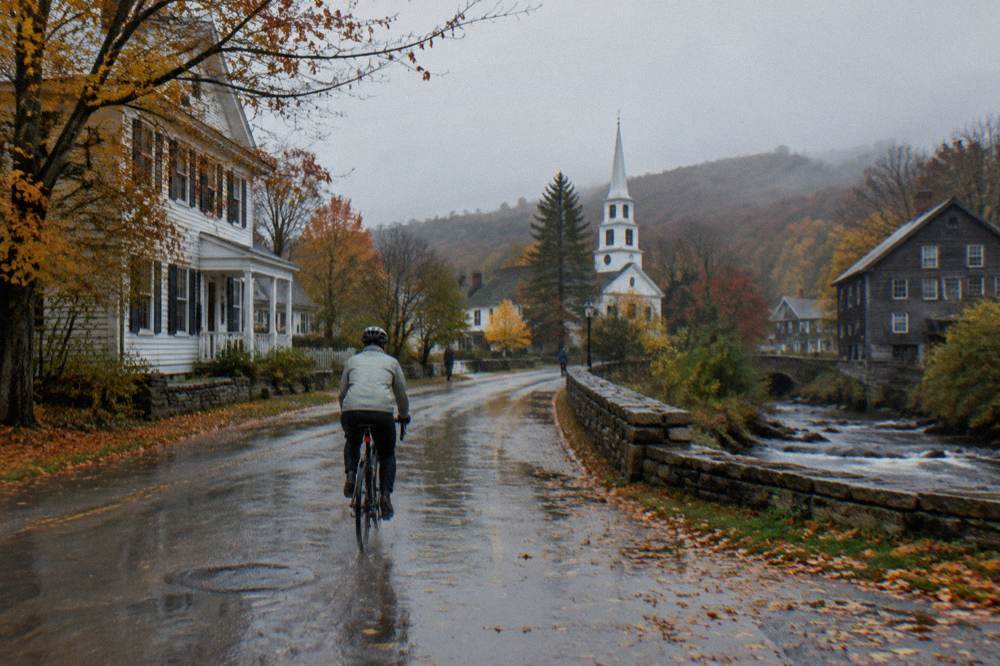
Match the lodging to the region that peaks in your week: a Kingdom base like Lyndonville for late September, a central base in Stowe or the Lamoille Valley for the first week of October, and a southern base like Woodstock or Manchester for mid October. Staying within a short ride or drive of two elevation bands buys insurance against a peak that arrives early or late.
The lodging picture splits along the same regional lines as the color. In the north, The Wildflower Inn in the Kingdom area, sits 2.3 miles from the Kingdom Trails network and runs bike rentals plus a bicycle shuttle, which effectively extends the riding day by removing the approach ride. In the center, Stowe carries the deepest bench: Sun & Ski Inn And Suites is listed as a base for the recreation path and village loops, The Lodge at Spruce Peak sits at the mountain for riders pairing the village path with a Mountain Road ride, and Stowe Motel & Snowdrift is the budget option in the same town. Burlington's two listed hotels, Hotel Vermont about 0.2 miles from the Burlington Bike Path and Hotel Champlain steps from Waterfront Park with the bike path access and free bicycle rentals listed on its page, cover the lakeshore window in the second week of October.
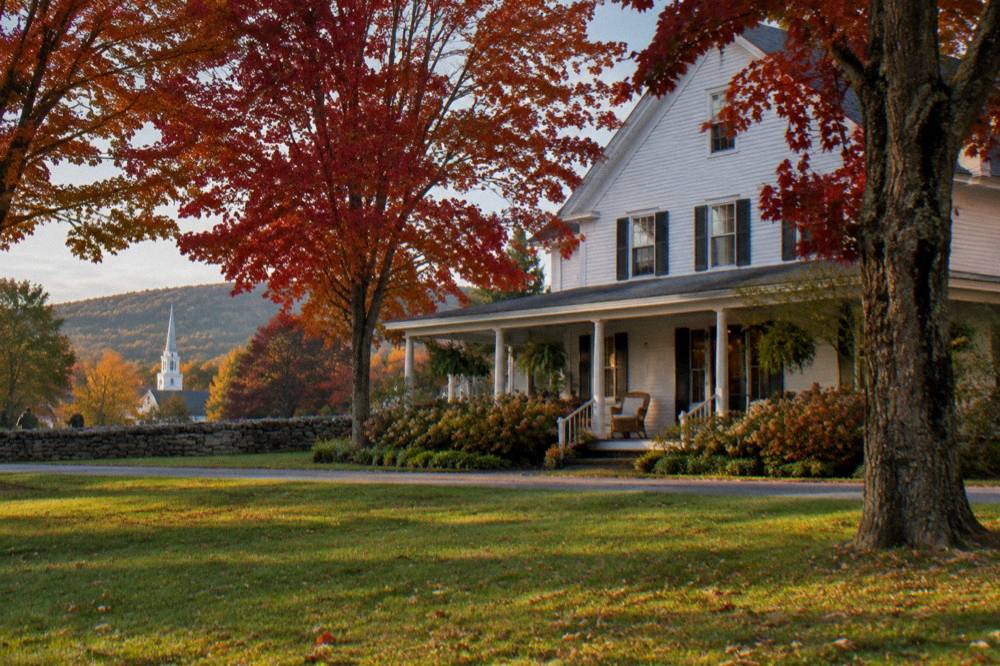
In the south, Woodstock Inn & Resort is the village base for the Woodstock gravel loops and the Mount Tom carriage roads, and The Equinox in Manchester anchors the southern road rides. The middle-of-state option is Middlebury, where the Swift House Inn and the Middlebury Inn both sit at the Trail Around Middlebury loop, a convenient central position for riders who want to chase the peak north or south on consecutive days. The Woodstock Inn & Resort in Woodstock village is the hotel base that fits the late southern window.
| Region and window | Hotel base | Why it works |
|---|---|---|
| Northeast Kingdom, late September to early October | The Wildflower Inn, Lyndonville | 2.3 miles from Kingdom Trails, with bike rentals and a bicycle shuttle |
| Stowe and the Lamoille country, first week of October | Sun & Ski Inn And Suites, The Lodge at Spruce Peak, Stowe Motel & Snowdrift | Direct access to the Stowe Recreation Path and Mountain Road loops |
| Burlington lakeshore, second week of October | Hotel Vermont, Hotel Champlain | 0.2 miles to the Burlington Bike Path, or steps from Waterfront Park with bicycle rentals listed |
| Southern valleys, mid October | Woodstock Inn & Resort, The Equinox | Bases for the Woodstock gravel loops and the Manchester road rides |
| Central chase position, whole season | Swift House Inn, Middlebury Inn | At the Trail Around Middlebury, within a drive of both northern and southern windows |
Whichever base a rider picks, the booking reality of foliage season is simple: the peak weeks fill the inns early, especially on weekends in the popular corridors. Midweek stays are easier to get, quieter on the roads, and, as the traffic reporting on the backroads suggests, often the better riding anyway.
Yes, and October is exactly when riders most often want one. Vermont treats Class 1 and Class 2 e-bikes as bicycles with motor assistance to 20 miles per hour and Class 3 to 28, and on the big rail trails like the Lamoille Valley, e-bikes are explicitly allowed. On natural-surface mountain bike trails the rules vary by land manager, so riders need to check the specific network.
The state-level picture is permissive on the surfaces a foliage rider is most likely to use. The Lamoille Valley Rail Trail's own pages state plainly that e-bikes are allowed on its 95 miles, alongside all other non-motorized uses, with ATVs, dirt bikes and similar motorized machines prohibited. The Burlington Greenway and the Island Line corridor likewise permit Class 1 pedal-assist e-bikes where bicycles are allowed, and Local Motion's Trailside Center at 1 Steele Street in Burlington rents them, alongside conventional, adaptive and kids' bikes, with reservations recommended. Rental prices are not published here; the center sets them.
Mountain bike country has the sharper rules. At Kingdom Trails, Class 1 pedal-assist eMTBs are allowed on most trails per the Kingdom Trails Association, with the trail map marking any landowner exclusions. On state land the current rule from the state's forests and parks staff is that e-bikes are prohibited on non-motorized natural-surface trails and allowed on roads and multi-use paths, with an expanded policy proposed but unconfirmed. Riders wanting the full detail can read the Vermont Mountain Bike Association's summary of where pedal-assist riding stands in Vermont. For foliage riders, the short version: rail trail and road e-biking is broadly open, singletrack e-biking depends on the network, and the map or the manager is the answer.
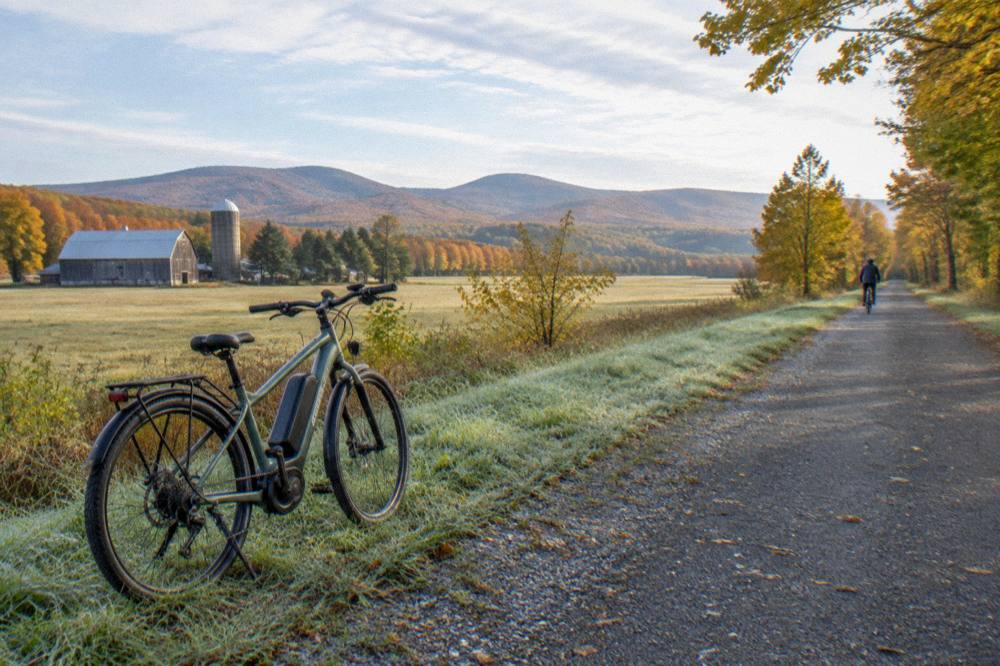
A good foliage route pairs a car-free spine, a rail trail or a recreation path, with quiet backroad or gravel loops, and keeps the busy numbered scenic corridors out of the plan. It includes some climbing early in the season to reach the higher color and drops into the valleys late, and it finishes before the daylight and the temperature both fall away in the late afternoon.
The state's ride inventory supports that shape almost everywhere. In the north, the Kingdom's trail network is the anchor for mountain bikers, and the Lamoille Valley Rail Trail runs west from St. Johnsbury as the road rider's spine, with the Missisquoi Valley Rail Trail's 26.4 miles joining it near Sheldon for riders building a longer valley tour. In the center, the Stowe Recreation Path and the Island Line Trail, about 14.4 miles Burlington to South Hero, are the two flagship car-free corridors, and each sits in a valley that colors on the later calendar. In the south, the Woodstock gravel loops and the Mount Tom carriage roads give dirt-road riders a mellow option that peaks with the mid-October valleys.
Route difficulty should drop as the season advances, not the other way around. Early-October rides in the hills can be full mountain days because the weather still supports them; by mid October the comfortable plan is valley rail trail and rolling gravel, with the climbing kept optional. Riders comparing surface choices will find the trade-offs laid out in our road versus gravel versus e-bike comparison for Vermont, and anyone building a multi-day trip around the color can lift the day-by-day structure from the three day Vermont fall itinerary.
Two route-level cautions close the planning. First, leaf-season traffic concentrates on a handful of famous driving roads, and a route that crosses them repeatedly will feel it; plan crossings at right angles and spend the miles on the parallel backroads. Second, check trail status before a long ride, especially after rain, since both the singletrack networks and the occasional rail trail segment close or detour for maintenance, and the managers post those updates before anyone discovers them at the trailhead.
Woodstock village
The village base for the Woodstock gravel loops and the Mount Tom carriage roads.
Check ratesThe typical statewide peak window is about October 1 to 9. The Northeast Kingdom peaks first, in late September to early October, central Vermont follows in early October, and the southern valleys reach peak around mid October.
The northern Northeast Kingdom, the Orleans, Essex and Caledonia county highlands, turns first, typically in late September. Its ridgelines can color even earlier, running ten to fourteen days ahead of the valleys below them.
The southern valleys of Windham and Bennington counties, plus the lake-moderated Champlain Valley shore, hold color latest, often into mid October and a few days beyond while the north stands bare.
Ridgelines typically run ten to fourteen days ahead of valleys. A route that climbs a few hundred feet effectively rides an earlier week of the season, which is why high routes are best early and valley rides best late.
Not in the south and along the lake. The northern hills are usually past peak by then, but the southern valleys and the Champlain shore are often at peak around mid October. Our [mid October foliage breakdown](/blog/is-mid-october-too-late-for-fall-foliage-in-vermont/) covers the question in detail.
Use the state's weekly foliage progress report for the color, and the trail manager's conditions page for the surface. Kingdom Trails and the state rail trail program both post live status, and riders should check both before a long fall ride.
Before you go, the pick for this guide:
Hotel Vermont
About 0.2 miles from the Burlington Bike Path in the lake-side downtown.
Check rates →