Which Town In Vermont Is Best For Fall Foliage?
A town-by-town comparison of the best Vermont foliage towns for riders, with trail access, peak timing windows, and where to stay near the riding.
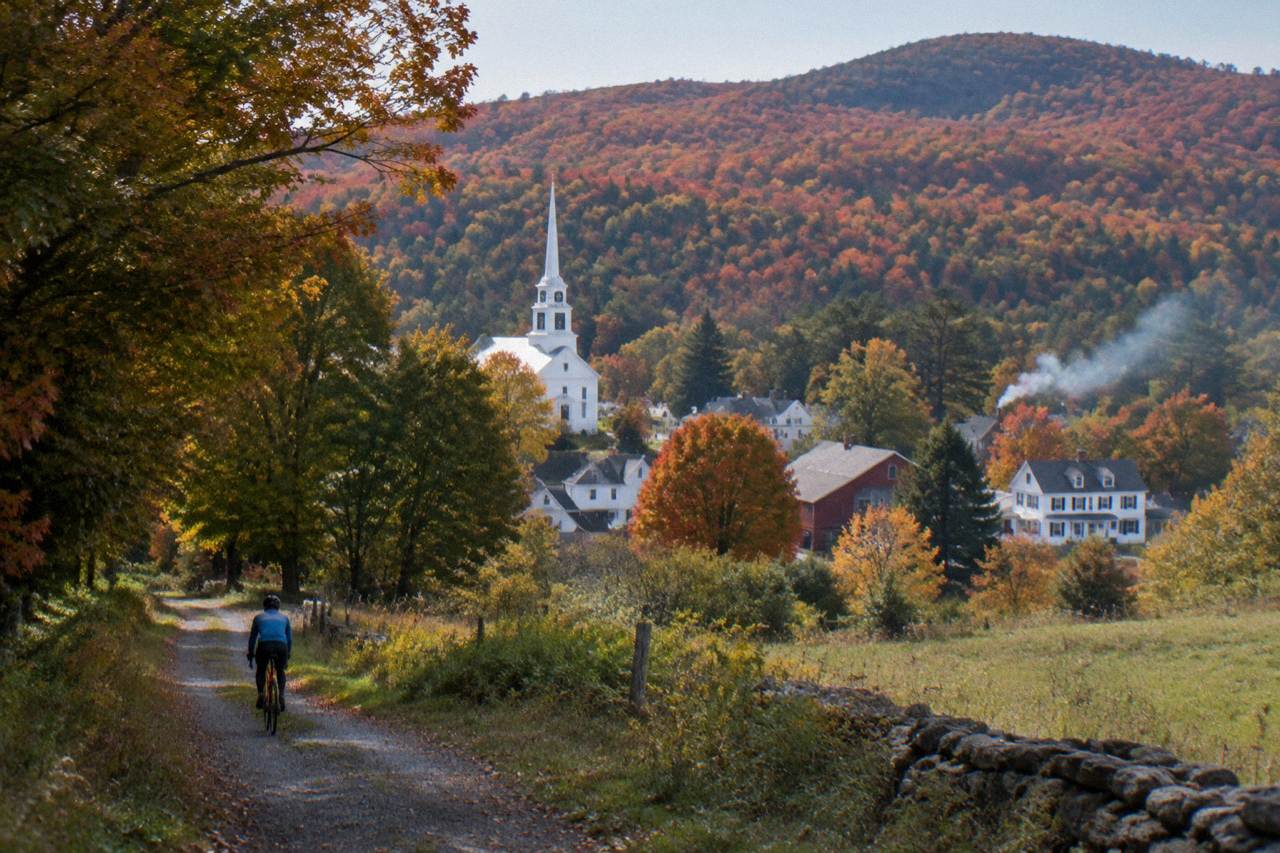
Church steeples, a general store, and a wall of red maple on the ridge behind it: that is the Vermont foliage postcard, and a dozen towns can stage it. The difference between a good foliage weekend and a great one is rarely the color itself. It is whether you can get out of the car and into it, on a bike, before the overlooks fill up. Riders get an angle on the season that leaf peepers in cars never find, because the quiet gravel roads and rail trails where the color is thickest are exactly where a bike works best. If you would rather have someone else handle the route planning, our guide to guided and self-guided Vermont foliage tours compares bike, bus, and train options side by side.
The honest answer to the question below is that the best town is a moving target. Color peaks in the northern high country in late September and reaches the southern valleys by mid October, a stagger of roughly two to three weeks driven by elevation. Pick the town to match your dates, and pick one with real riding out the door, and you will beat the traffic on Route 100 while the scenic-drive crowd sits in it. The full regional timing breakdown lives in our guide to Vermont foliage peak dates by region, which is the companion piece to this shortlist.
Top Towns Shortlist
Woodstock is the strongest single answer for most visitors, and Stowe is the strongest for riders. Woodstock pairs a preserved village, the Mount Tom carriage roads, and a web of gravel loops out the door; Stowe pairs longer visitor infrastructure with the Recreation Path and the Mountain Road climbs. Both hold peak color in the first ten days of October. For late September, East Burke peaks earliest of all.
That three-way shortlist is not a ranking of prettiness, because at peak every one of these towns photographs identically well. It is a ranking of what you can do once the camera is back in the pocket. Woodstock's quiet secret is that its best foliage riding is not on the roads at all but on the carriage roads of Mount Tom, crushed-stone lanes built for horses that now carry walkers and bicycles under a closed canopy. Stowe's is that the Recreation Path threads the village from end to end, so a family on hybrids can ride through the color without ever touching a public road.
East Burke is a different animal entirely. It exists because of Kingdom Trails, a network of more than 100 miles of singletrack and multi-use trail across working farmland and forest, and in late September it sits in the first part of the state to turn. The town itself is a hamlet of a few hundred people, a general store, and a bike shop at the trailhead, which is either the point or the problem depending on what kind of foliage weekend you want. Our Kingdom Trails mountain biking guide covers the riding in detail.
When Does Each Region Of Vermont Reach Peak Color?
The Northeast Kingdom peaks first, typically in late September to the first days of October, because it is the highest and northernmost terrain. Central Vermont, including Stowe, Woodstock, and the Green Mountain ridgelines, peaks in roughly the first week of October. The southern valleys around Manchester and Wilmington hold on until mid October. Ridgelines run ten to fourteen days ahead of the valleys even within one region.
That stagger is the single most useful piece of foliage planning knowledge, and it is why arguing about the best town is mostly arguing about dates. A rider who can only travel the last weekend of September should not be in Woodstock hoping for peak; the maples on the Mount Tom summit will be turning while the village sugar maples are still green. Flip it around, and the Columbus Day weekend traveler who heads to East Burke will find bare birches, while the same weekend in Readsboro or Grafton can still deliver a full canopy.
Within any single town, elevation does the same work on a smaller scale. The color climbs. Valley floors hold green longer, mid-slope hardwoods turn first and hardest, and the ridgeline above can be past peak while the churchyard maples in the village are just lighting up. A rider with gears gets to surf that gradient in a single morning: climb into the color, descend through it. A car gets one overlook and a parking problem.
Why Does Stowe Work So Well For A Foliage Bike Trip?
Stowe gives a rider the rare combination of a traffic-free path through the village, hard climbs with ridgeline views, and a full town of places to eat and sleep at the end of it. The Stowe Recreation Path runs alongside the West Branch and the Mountain Road climbs toward Smugglers Notch, so a household with mixed ambitions, path riders and hill climbers, can split up and reunite for lunch. Peak color lands in early October.
The Recreation Path is the spine. It is paved, it is separated from traffic, and it threads between the village and the base of the mountain through field and riverbank, which in early October is a sequence of gold birch and red maple frames. Families towing kids in trailers use it, road riders warm up on it, and it connects directly to lodging, which matters when the parking lots at the popular stops fill by mid morning. Riders who want more can continue up the Mountain Road shoulder toward the Notch, where the cliffs and the closed canopy make the most theatrical foliage wall in the state.
The practical advice is timing. Stowe is one of the two or three most visited foliage towns in Vermont, and the weekends around peak fill the village and the road shoulders. Midweek in the first week of October is the sweet spot: full color, open tables, and a path you can actually ride at pace. Anyone planning a broader trip through the region will find more route ideas in our piece on Stowe Recreation Path and Lamoille County biking.
For a base, a motel or inn in the village keeps the path in walking or rolling distance, and the Sun & Ski Inn And Suites puts you in Stowe for both the Recreation Path and the road loops around the village without loading a bike rack once.
Why Do Riders Keep Choosing East Burke In Late September?
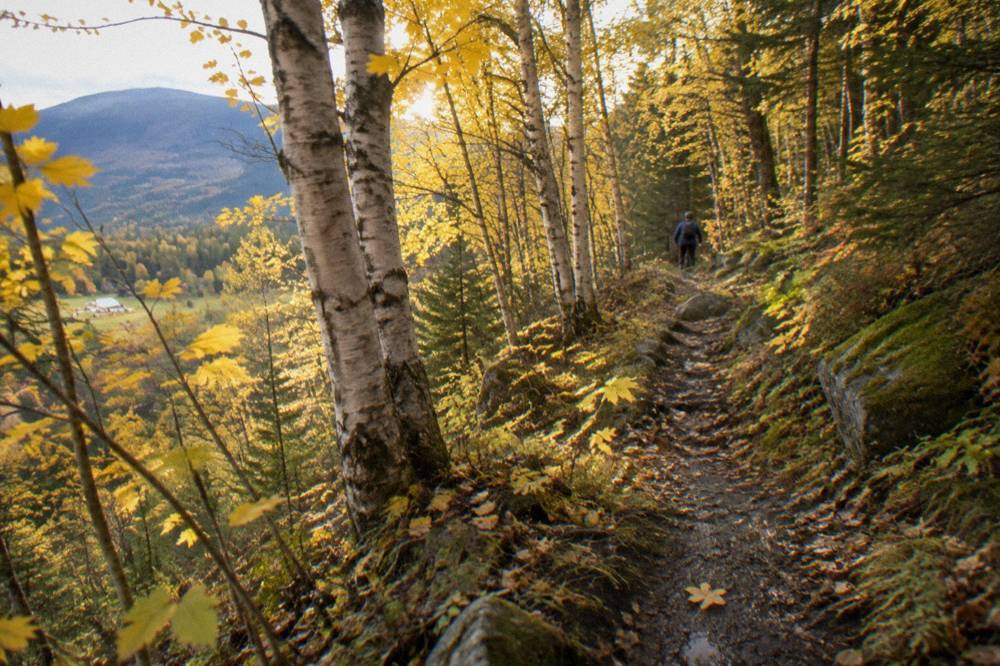
East Burke peaks before anywhere else on this list, usually in the last days of September, and it is the only town here where the foliage viewing happens at mountain bike speed on singletrack rather than from a road. Kingdom Trails runs across barns, pastures, and forest above the village, and riders report that the flow trails through the birch glades are the best color immersion in the state. The trade is a tiny town and slim services.
The experience is unlike the other foliage towns because the land is unlike them. Kingdom Trails is a partnership between the association and dozens of private landowners, so the riding moves through working dairy country, not preserved postcard scenery, and the color comes with cows and sugarhouses in the frame. The trails close for the season around the end of October and then shut again for deer hunting before the groomed winter fat bike network opens, so the foliage window is also most of the riding window. Check the trail conditions page before committing a day, because the association closes trails after rain to protect the surface, and passes are bought through the Kingdom Trails Association store or the Welcome Center on Route 114 in East Burke.
Lodging near the network matters more here than in the big towns, because the nearest full-service towns are twenty minutes in either direction. The Wildflower Inn in Lyndonville sits 2.3 miles from Kingdom Trails, offers bike rentals and a bicycle shuttle, and sits in the part of the state where the color turns first, which makes it a genuine late-September play.
Why Is Woodstock The Postcard Pick?
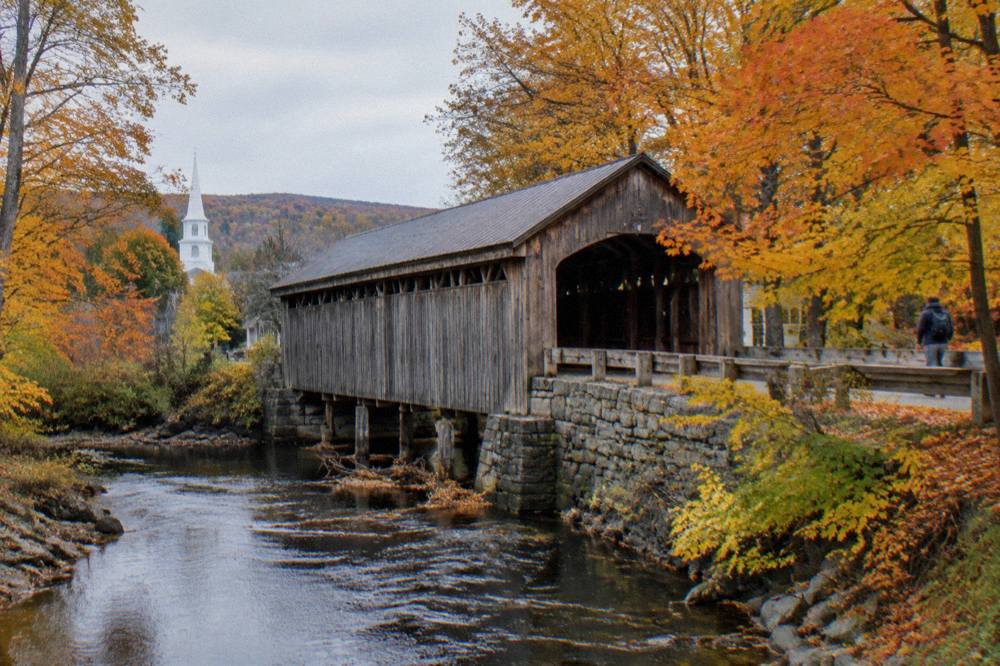
Woodstock is the town that matches the photograph people have in their heads before they arrive: a village green, a covered bridge, brick storefronts, and hillside sugar maples that turn uniformly because the village is old enough to have matured its tree canopy. The Mount Tom carriage roads and the surrounding gravel loops give riders car-free and low-car alternatives, and peak color arrives in early October with the rest of central Vermont.
What separates Woodstock from equally pretty villages is the trail system most visitors never hear about. The carriage roads on Mount Tom, reached from the village, are crushed-stone lanes that climb gently through hardwood forest to views over the Ottauquechee Valley, and bicycles are welcome on them. Gravel riders can string together town-maintained dirt roads toward South Woodstock and Barnard that hold almost no leaf-season traffic, because the scenic-drive crowd is on the state highways, not the class 4 roads. A rider can leave the village green, climb into full color, and be back for lunch without competing with a single tour bus.
The village itself rewards the low-key pace a bike enforces. The covered bridge at the edge of the center, the river walk, and the graded village streets make it one of the few foliage towns where walking the bike between stops feels like the intended way to see it. Our best towns in Vermont for fall foliage guide expands on the town-to-town logic, and our 3-day Vermont fall itinerary shows how to chain Woodstock with a second base. If you'd rather compare a few candidate bases before committing, our descriptive rundown of the top foliage towns lays out what each one does best.
Staying in the village puts the carriage road trailhead and the gravel loops in easy range, and the Woodstock Inn & Resort is the village base for exactly those rides.
Woodstock Inn & Resort
Woodstock village
The village base for the Woodstock gravel loops and the Mount Tom carriage roads.
Check ratesWhat About Burlington And The Champlain Valley?
Burlington peaks later than the mountain towns, often in the second week of October, and it offers something none of the villages can: flat, paved, lakeside riding with the Adirondacks as a backdrop to the color. The Burlington Greenway and the Island Line Trail run out along the lake and across the Colchester Causeway, and the city's bike infrastructure means a foliage weekend here does not require a car at all.
The color story is different at lake level. The Champlain Valley is low, so it turns after the hills, and the payoff is a longer usable season: riders can still find strong color on the lakeshore in mid October when East Burke is bare. The riding is on separated path almost throughout, roughly eight paved miles of Greenway in the city and then crushed gravel out the causeway toward the Champlain Islands, with the lake on one side and valley color on the other. Local Motion, the nonprofit that runs the Trailside Center on the waterfront at 1 Steele Street, rents conventional, Class 1 e-bike, adaptive, and kids bikes, with reservations recommended, and its bike ferry across the causeway gap typically runs late May to mid October on a seasonal schedule, so check the ferry page before planning an Islands crossing. If you're worried the window has closed, our guide to mid October foliage timing in Vermont covers exactly which low elevation spots still hold color and what riding conditions to expect that late in the season.
Burlington is also the foliage answer for mixed groups. The non-riders get a college town's restaurants and a pedestrian marketplace; the riders get a car-free trail out the door; and nobody spends the weekend in traffic on a mountain road. The trade is honest: this is not the deep, closed-canopy immersion of the Kingdom or the steep drama of Stowe. It is big-sky color, water and hills together, at a pace a twelve-year-old can hold.
How Do You Match A Town To Your Riding Style?
Match terrain first and color second, because the color is nearly guaranteed somewhere but the riding is fixed. Mountain bikers should be in East Burke, path and family riders in Burlington or Stowe, gravel riders in Woodstock or the Northeast Kingdom, and road climbers in Stowe or the Mad River Valley. Every one of those towns sits inside reach of peak color in the first ten days of October.
| Town | Best riding style | Signature ride | Typical peak window |
|---|---|---|---|
| East Burke | Mountain biking | Kingdom Trails singletrack | Late September to early October |
| Stowe | Road, path, mixed | Recreation Path and Mountain Road | Early October |
| Woodstock | Gravel, car-free paths | Mount Tom carriage roads | Early October |
| Burlington | Flat path, family | Greenway and Island Line Trail | Early to mid October |
| Manchester | Road riding | Southern valley road loops | Mid October |
The pattern in the table is deliberate: the row order is also the calendar. A rider with a flexible month could honestly start in Burke in the last week of September on a mountain bike, move to Stowe or Woodstock on gravel in the first week of October, and finish on the Burlington lakeshore in the second week, riding peak color the whole way south and down. That is a three-week foliage campaign rather than a weekend, but it shows why the best-town question has no single answer, only a best answer per week.
Where Should You Stay To Ride The Foliage Without Driving?
Stay in the village you plan to ride out of, not the one with the most famous photograph. In Stowe, Woodstock, and East Burke, lodging within rolling distance of the trail or path removes the foliage weekend's biggest tax, which is moving a car between trailheads and parking along crowded scenic roads. In Burlington, a downtown stay puts the Greenway at the door and a rental bike replaces the car entirely.
The logic is arithmetic as much as aesthetics. A foliage weekend in a popular town means scarce parking, filled restaurants, and a slow shuffle on the main road. A base within a mile of the riding converts all of that dead time into riding time, and the same village that is gridlocked at eleven in the morning is empty and gold at eight. Riders who take the early morning seriously are routinely rewarded with the best light of the day and the trails to themselves, then get breakfast when the town wakes up.
Choosing between bases is mostly choosing between riding cultures. The inns of the villages suit riders who want dinner reservations and a porch; the motel and inn options around Burke suit riders who want to be first in the parking lot and last out. Our inn to inn bike tours in Vermont guide covers the multi-base version of the same idea, where the luggage moves and the riding connects the towns.
The Wildflower Inn
Lyndonville, 2.3 miles to Kingdom Trails
Offers bike rentals and a bicycle shuttle, and sits 2.3 miles from Kingdom Trails.
Check ratesWhat Should You Know About Riding Vermont Roads In Leaf Season?
Three things shape an October ride: short daylight, narrow shoulders, and wet leaves. Sunrise sits near seven and sunset near six twenty early in the month, so plan the long climb for midday and finish rides with light to spare. Many rural roads have minimal shoulder, and fallen leaves on pavement hide potholes and turn slick after rain, so brake early and round corners gently. Layer for mornings near freezing and afternoons in the fifties.
The traffic pattern deserves one line of realism. Vermont's backroads stay quiet even in peak foliage, but the named scenic corridors, Route 100 above all, concentrate both the views and the cars. Riders planning a road loop should route the marked scenic byways for the midday segment when sightlines are long, or better, move the whole route onto gravel, where the leaf-peeping traffic essentially disappears. The state's rail trails, which are open to bikes year-round and allow e-bikes under the state rail trail rules published at railtrails.vermont.gov, are the other car-free foliage option, and the 95-mile Lamoille Valley Rail Trail alone passes through a string of small towns that peak on the northern schedule.
Equipment follows from the conditions. Wider tires than you would run in summer, for the leaf cover and the occasional gravel section; lights even on a planned daylight ride, because an October sky can go dim by five; and a real layering system, because a ride that starts at frost can end warm enough for short sleeves. Helmets stay on, as always. Our what to bring on a Vermont bike tour checklist covers the packing version of the same advice.
Is Mid October Too Late For Foliage Anywhere In Vermont?
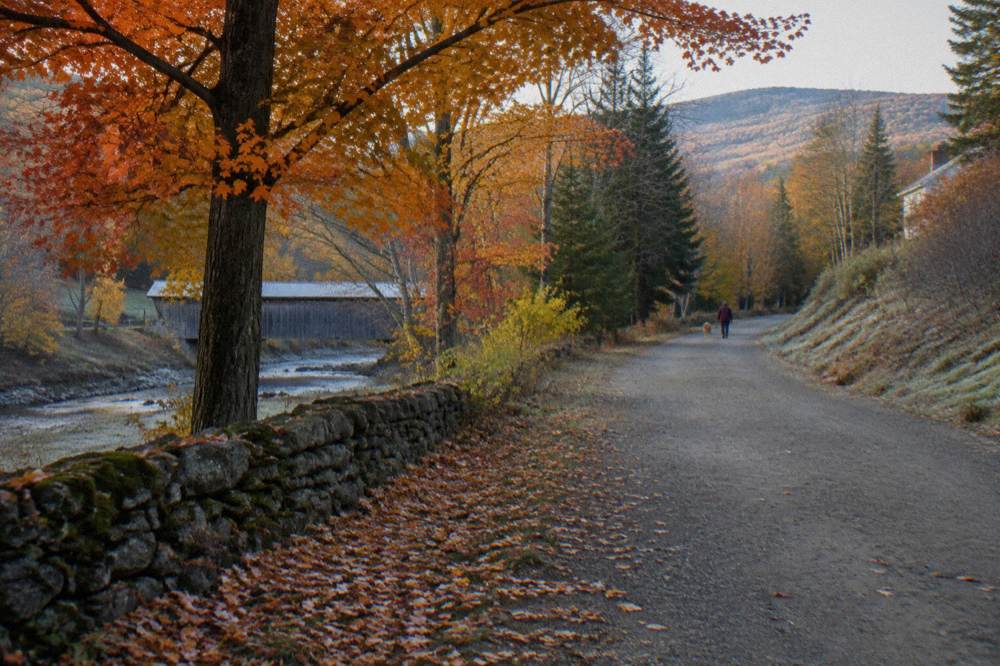
It is too late for the mountains but not for the valleys. By mid October the Northeast Kingdom and the Green Mountain high country are past peak and dropping leaves, while the Champlain Valley, the Connecticut River valley, and the southern counties around Manchester and Wilmington often still hold full color. Mid October riders should plan south and low, and Burlington or Manchester beat Stowe or Burke on the calendar.
This is the most common planning mistake, and it is avoidable with one rule: follow the elevation down. Every week of October, the usable foliage line moves downhill and southward, so the rider who booked Stowe for the third week of the month arrives to find the maples bare on the hillsides and the best remaining color along the river bottoms. The same week in Manchester, with its low southern valleys, can still look like the postcard. The lakeshore around Burlington behaves the same way, which is why the Island Line crossing stays a strong ride deep into the month while the hill towns wind down.
Mid October also has its own quiet advantages. The crowds thin the weekend after the peak photographs hit the news, lodging opens up, and the light gets long and low, which is arguably better for riding than the flat bright skies of the first week. Our piece is mid October too late for fall foliage in Vermont takes the question head on for late-season planners.
Common Questions About The Best Vermont Foliage Towns
Which Town In Vermont Is Best For Fall Foliage?
Woodstock is the best single answer for a classic village foliage weekend, Stowe is the best for riders who want a mix of path and mountain climbs, and East Burke is best in late September for mountain bikers. The best town for you depends on your dates, because peak color moves from the northern high country in late September to the southern valleys by mid October.
What Month Is Peak Foliage In Vermont?
The statewide peak window in a typical year runs about October 1 to 9. The Northeast Kingdom peaks first, in late September to early October, central Vermont peaks in the first week of October, and the southern valleys hold color into mid October. Ridgelines turn ten to fourteen days ahead of valley floors.
Is Stowe Or Woodstock Better For A Bike Trip?
Stowe is better for riders: the Recreation Path gives traffic-free riding through the village, and the Mountain Road offers a serious climb toward the Notch. Woodstock is better for a quieter, car-light weekend built on the Mount Tom carriage roads and gravel loops, with the more classically preserved village. Both peak in the same early October window.
Can You See Foliage From A Bike In Burlington?
Yes. The Burlington Greenway and the Island Line Trail run about 14 miles from the city waterfront out across the Colchester Causeway toward South Hero, with lake views and valley color. Burlington is low and turns late, so mid October often still has strong color there when the mountain towns are past peak.
Where Should Mountain Bikers Go For Fall Color?
East Burke. Kingdom Trails offers more than 100 miles of singletrack and multi-use trail through farmland and forest, and the Northeast Kingdom peaks earlier than anywhere else in the state, typically in late September. Buy passes through the Kingdom Trails Association and check trail conditions before riding, since trails close after rain.
Is Mid October Too Late For Vermont Foliage?
Not everywhere. The mountains and the Northeast Kingdom are past peak by mid October, but the Champlain Valley, the Connecticut River valley, and the southern counties around Manchester often hold full color into the second or even third week. Plan south and low for late trips.
Whatever town you pick, the riding version of foliage season beats the windshield version, and Vermont Biking Tours exists to help you plan it. Choose the week, choose the terrain, and let the color come to you at the speed of pedals instead of the speed of the car in front of you.