Is Vermont Good For Mountain Biking?
An honest look at mountain biking in Vermont: the trail networks, the scale of the systems, the riding season, and how the state compares for a bike trip.
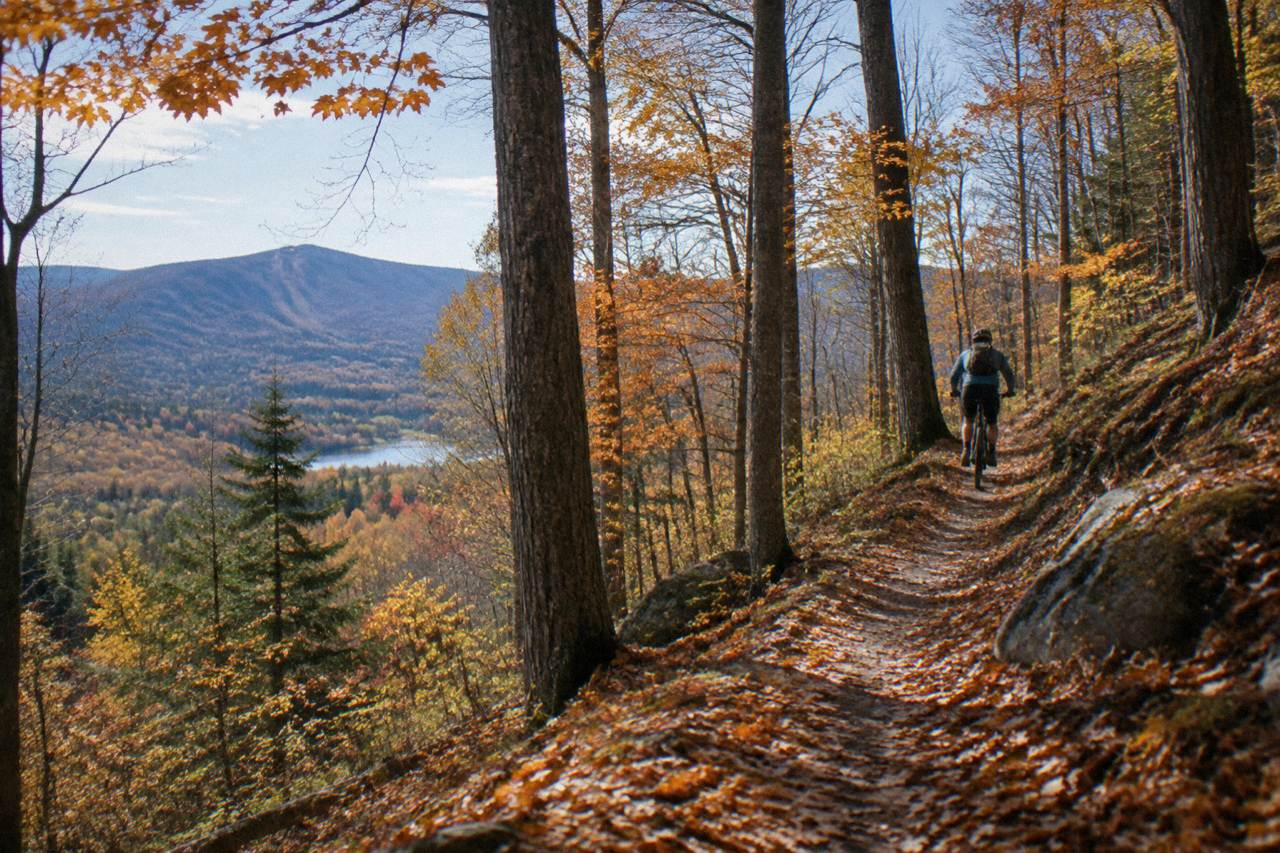
Riders coming from states where mountain biking means scraped-together loops on public land tend to underestimate Vermont. The state runs on a model few places match: a nonprofit trail association, a landowner network, and a mountain bike community that builds and maintains singletrack at a scale that draws riders from across the Northeast and beyond. The centerpiece, Kingdom Trails in East Burke, counts 213 trails and more than 100 miles of non-motorized singletrack and multi-use trail on its network. That alone answers much of the question, but not all of it, because a good mountain biking state needs more than one famous network, and Vermont has that too.
Vermont Mountain Biking Overview
Yes, and by eastern United States standards it is one of the best. Vermont combines a flagship destination, Kingdom Trails, with a deep bench of regional networks, a statewide trail association structure, rideable dirt roads that link everything, and a season that stretches from roughly May through late October, plus a groomed winter fat bike network in the Northeast Kingdom. The honest caveat is scale: no Vermont network matches the raw mileage of the biggest western destinations.
What Vermont does instead is concentrate quality. The riding here is flow-heavy, forested singletrack built for repeat laps rather than epic point-to-point wilderness routes. The Green Mountains and the Northeast Kingdom give the terrain sustained climbs, rolling ridge lines, and gladed hardwood forest that turns into one of the best-looking riding environments anywhere in leaf season. The trade-off against big western riding is vertical: Vermont climbs are real but shorter, and the networks are loop-based, so you build mileage by linking rather than by traversing.
The other thing that makes the state work is organizational. The Vermont Mountain Bike Association coordinates a web of local chapters, each of which builds and maintains its home network, negotiates with landowners, and publishes conditions. That structure is why trail quality in Vermont holds up across so many towns, and why a rider can plan a week of mountain biking across three or four separate networks without ever riding a mediocre trail.
Where Is The Best Mountain Biking In Vermont?
East Burke, in the Northeast Kingdom, is the statewide answer and a national-level one. The Kingdom Trails network offers 213 trails and over 100 miles of singletrack and multi-use trail across working farmland and forest, with something for every skill level. Behind it sit strong regional networks around Stowe, the Mad River Valley, Woodstock, and Pine Hill in Rutland, each with its own chapter and character.
Kingdom Trails deserves its reputation, and the numbers explain why. The network runs across dozens of private landowners who allow public riding through the association's agreements, which is why a pass is required for access, bought online through the Kingdom Trails Association store or in person at the Welcome Center on VT Route 114 in East Burke. Pass prices change, so check the association's store for current figures rather than relying on older numbers floating around online. The summer season runs when conditions allow, typically from May through the end of October, after which the network pauses for deer season before the winter fat bike and Nordic setup opens.
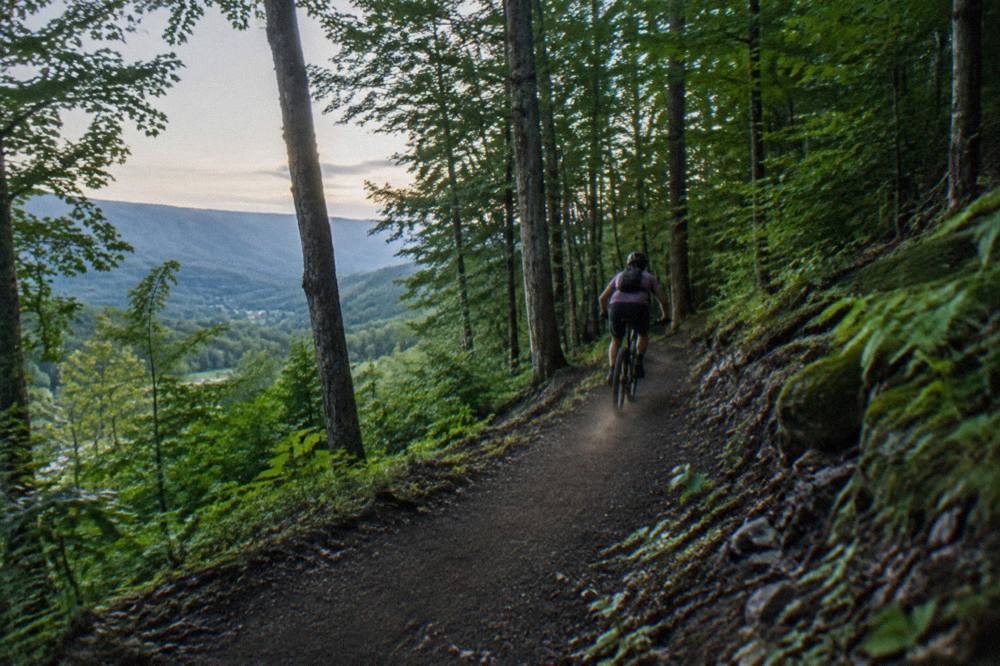
The rest of the state is not an afterthought. Stowe's network connects to the town's recreation path system and the riding around Mount Mansfield's foothills. The Mad River Valley packs a dense, technical network into a small area. Woodstock's trails link to gravel roads and the carriage roads on Mount Tom, which makes it a good place to mix mountain biking with easier riding. Our longer Kingdom Trails mountain biking guide covers that network in detail, and the broader rundown of mountain biking in Vermont maps the regional options.
The short version for trip planning: base yourself at one network for two or three days rather than trying to sample everything. Drive times between networks are realistic, often under an hour and a half, but the riding at each is deep enough that moving daily costs more than it gains.
How Does Vermont Compare To Other Mountain Biking States?
Against its regional neighbors, Vermont wins outright: no other New England state combines a destination network of Kingdom Trails' size with so many supported regional systems. Against the mountain West, the honest answer is that Vermont trades vertical and raw mileage for density, accessibility, and flow, and in fall it trades them for scenery that no desert system can match. It is a top-tier eastern destination rather than a global one.
| Comparison point | Vermont | Typical western destination | Verdict for Vermont |
|---|---|---|---|
| Flagship network size | 100+ miles, 213 trails | Often 100 to 400+ miles | Competitive, not dominant |
| Vertical per climb | Short but repeated | Long sustained descents | West wins on vert |
| Trail density per drive hour | Very high across small state | Spread across huge distances | Vermont wins |
| Season | Roughly May to late October, plus winter fat biking | Longer in the desert Southwest | Depends on region |
| Fall riding scenery | Among the best anywhere | Variable | Vermont wins |
The density point matters more than riders expect. In Vermont you can ride a full morning at one network, drive 45 minutes, and ride a completely different style of trail in the afternoon. In much of the West, trailheads are hours apart. That makes the state unusually good for a short bike trip, especially a long weekend built around one or two towns. One flat-water classic worth tucking into a weekend like that is the causeway ride across Lake Champlain, and our guide to biking the Colchester Causeway covers the distance, surface, ferry gap, and timing.
Where Vermont honestly loses: elevation, season length in a hard winter for standard mountain biking, and the absence of true alpine terrain. If your reference point is lift-served mountain biking down a huge mountain descent, Vermont's model of pedaled loops will feel different, though lift-accessed mountain biking does exist at some of the state's ski resorts on their summer schedules.
When Is The Mountain Biking Season In Vermont?
The core mountain biking season runs from roughly May, when trails dry out and networks open as conditions allow, through late October, when most close for the season. The Northeast Kingdom's winter network then opens groomed singletrack for fat bikes with tires wider than 3.5 inches on designated trails only, so with the right bike and clothing, riding in Vermont never fully stops. Late September to mid October is the scenery peak.
Spring is the tricky part. Vermont trails hold moisture late, and riding saturated singletrack damages it, which is why networks publish conditions and why responsible riders check them. The associations are explicit about this: a trail closed for mud is closed for a reason, and the same landowner agreements that make the networks possible depend on riders respecting closures. By late spring the networks open fully, and summer delivers the most reliable conditions of the year.
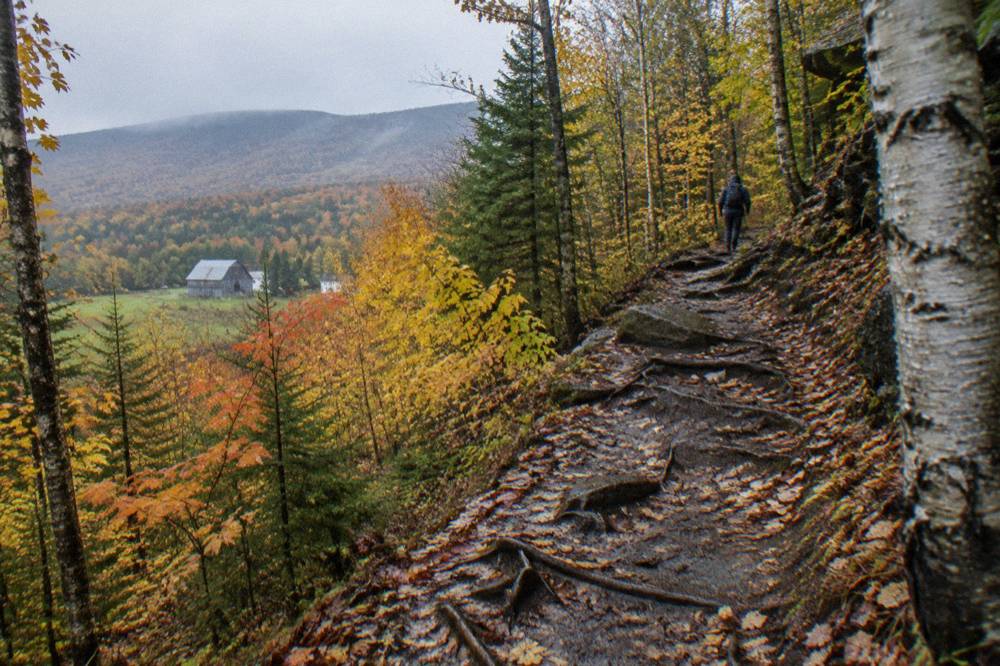
Fall is the season that sells the state. The typical peak foliage window runs late September to mid October, with northern ridgelines turning about a week to two weeks ahead of the southern valleys, and October days averaging roughly a high in the mid 50s and a low in the mid 30s Fahrenheit: crisp, cold-started, perfect midday riding weather. Daylight shrinks, so plan rides to finish by early evening. Our piece on the best time to bike in Vermont works through the timing in more depth.
Winter riding is a genuinely Vermont thing rather than a novelty. The groomed fat bike network in the Northeast Kingdom is one of the more developed winter setups in the country, and the same association infrastructure that maintains summer trail maintains it.
Do You Need A Pass Or Permit To Ride Vermont Trails?
At Kingdom Trails, yes: riding requires a pass, sold online through the Kingdom Trails Association store or in person at the Welcome Center in East Burke, and the revenue is what pays for the trail network's maintenance and landowner relationships. At most smaller chapter networks around the state, access is free or donation-based, though some ask for contributions. Pass prices are not fixed in this guide; check the association's store for current pricing.
The pass model is worth understanding because it explains why the trails are so good. Kingdom Trails crosses private land under agreements negotiated by the nonprofit association, and pass revenue funds everything from trail crews to insurance to the winter grooming operation. Riders sometimes balk at paying for a ride, but this is the same model as a ski area without the lifts, and it is why the network has grown to 213 trails rather than stagnating. Other pages covering the same trip are gathered on Vermont Biking Tours.
At the state level, the rules differ by land type. On Vermont state land, e-bikes are currently prohibited on non-motorized natural-surface trails, though allowed on roads and multi-use paths, and the Vermont Mountain Bike Association tracks a proposed policy that would expand Class 1 access, though its adoption is unconfirmed. At Kingdom Trails itself, Class 1 pedal-assist eMTBs are allowed on most trails per the Kingdom Trails Association, with the trail map marking any landowner exclusions. Riders bringing an e-bike should check the Kingdom Trails site and trail map before arriving.
Is Vermont Mountain Biking Good For Beginners?
Yes, strongly. Vermont's networks were largely built as community trail systems, which means most include green and blue flow trails designed for riders learning the sport, and the standout feature is progression: networks like Kingdom Trails deliberately ladder from wide, smooth beginner loops to progressively tighter and steeper singletrack within one connected system, so a mixed-ability group can ride the same trailhead all day.
The beginner infrastructure is real, not token. Kingdom Trails in particular is known for its family-friendly flow, with machine-built trails that let new riders carry speed safely, and the network's multi-use designation means fat-tire riders, runners, and walkers share space politely. Local chapters elsewhere follow the same pattern: a skills loop or beginner pod near the trailhead, then harder trail deeper in.
For riders new to the sport, two practical notes. First, conditions checking applies double to beginners, since wet roots and rock are the main technical features here and they get slippery after rain. Second, rentals are widely available near the major networks, so nobody needs to buy a bike to try Vermont riding: in the Burke area, East Burke Sports, Kingdom Bike Rentals, Village Sport Shop, and Rifugio Darling Hill all serve the Kingdom Trails crowd, and our overview of Kingdom Trails bike rentals and guided rides covers the options. Rental pricing varies, so confirm with the shop directly.
Where Should You Stay For A Mountain Biking Trip In Vermont?
Base in the town attached to your trail network, not between networks. For Kingdom Trails, East Burke and Lyndonville put you minutes from the trailhead; for the Stowe network, the village and Mountain Road corridor work; for Woodstock's trails and carriage roads, the village itself. A good rule is to stay within a short drive of the trailhead so you can ride early, when trails are firmest and traffic is lightest. Once you've picked your home base, our guide to the best road, gravel, and mountain bike rides across Vermont helps you plan the routes worth pedaling from your doorstep.
In the Northeast Kingdom, The Wildflower Inn sits 2.3 miles from Kingdom Trails in Lyndonville and offers bike rentals plus a bicycle shuttle, which removes the daily parking question entirely. Around Stowe, Sun & Ski Inn And Suites positions you for the recreation path and the road loops around the village, a good combination for a group where not everyone wants singletrack every day.
The Wildflower Inn
Lyndonville, 2.3 miles to Kingdom Trails
Offers bike rentals and a bicycle shuttle, and sits 2.3 miles from Kingdom Trails.
Check ratesFurther south, Woodstock Inn & Resort makes a comfortable base for the Woodstock gravel loops and the Mount Tom carriage roads, riding that suits mixed-ability groups and riders who want beautiful over burly. Wherever you land, book early for the late September to mid October foliage window: it is the busiest stretch of the Vermont riding year, and towns the size of East Burke fill up.
What Kind Of Terrain And Trails Should You Expect?
Expect rolling, flow-oriented singletrack through hardwood and spruce forest, with roots, granite, and occasional punchy climbs rather than long alpine descents. Vermont trail building leans toward machine-shaped flow trails and hand-built technical trail in equal measure, and the state's gladed terrain means tight trees, quick transitions, and trails that change character completely between dry summer and damp fall conditions.
The signature Vermont experience is flow through trees. Networks here reward cornering and pumping more than big-air riding: bermed descents link into rolling ridge lines, and the climbing is steady rather than brutal. Rock gardens exist, especially on older hand-built trail, and the wet-climate roots are the state's most consistent technical feature. A rider comfortable on intermediate trail almost anywhere will find plenty to love; an advanced rider will find black and double-black options concentrated at the bigger networks.
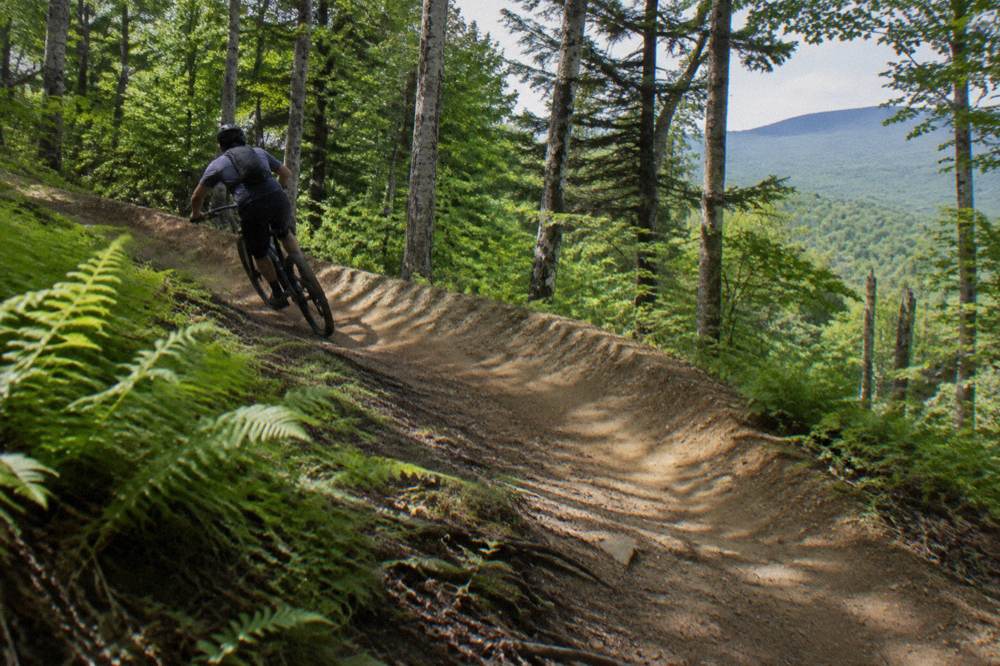
Two terrain features deserve advance notice. First, Vermont's trails drain unevenly: a network can be dry on its ridge lines and saturated in its valleys the same morning, which is exactly why conditions reporting exists. Second, the networks interleave with working farmland, especially around Burke, so a ride can move from deep woods to open pasture and back within one loop, and cattle, farm equipment, and landowner privacy norms are part of the deal. The association's ride-with-gratitude guidance lays out the etiquette.
Can You Ride E-Bikes On Vermont Mountain Bike Trails?
It depends on the land. At Kingdom Trails, Class 1 pedal-assist eMTBs are allowed on most trails per the Kingdom Trails Association, with the trail map marking landowner exclusions. On Vermont state land, e-bikes are currently prohibited on non-motorized natural-surface trails and allowed on roads and multi-use trails. A proposed policy would expand Class 1 access on state land, but adoption is unconfirmed, so check before you ride.
For riders planning an e-assist trip, the Northeast Kingdom is the friendliest destination in the state, since the Kingdom Trails policy is explicit and the rental shops around Burke, including Kingdom Bike Rentals and Rifugio Darling Hill with their eMTB focus, cater to it. Elsewhere, check the local chapter's rules, because networks on municipal or private land set their own policies, and a state-land prohibition does not automatically extend to them, nor does a private network's permission extend to state trail. The safest planning move is to verify each network's current e-bike rule on its own page before loading the bike rack.
What Does A Vermont Mountain Biking Trip Actually Look Like?
The classic version is a long weekend: two or three nights in one trail town, riding the home network daily, with a half day of gravel or rail trail riding mixed in for recovery. Vermont rewards depth over breadth, and because networks, food, and lodging sit close together, a rider can log serious mileage without long daily shuttles. A first trip built on East Burke or Stowe is the standard recommendation.
A sensible East Burke itinerary: arrive, check trail conditions, pick up a pass and any rental at the trailhead area shops, and ride the beginner-to-intermediate flow loops the first afternoon. Day two, go deep into the network's back trails. Day three, spin out on the Lamoille Valley Rail Trail, a 95-mile crushed-stone path that passes through the region and gives the legs a flat recovery day, or simply ride a second lap of favorites before driving home. The full picture of that rail trail is in our Lamoille Valley Rail Trail biking guide.
The mix of singletrack and rail trail is genuinely a Vermont strength, and it is why the state suits groups with mixed confidence. A nervous rider can spend the trip on the Island Line Trail or the Stowe path while the rest of the group rides singletrack, and everyone meets for dinner. Very few destinations offer both at this quality within a short drive of each other.
Sun & Ski Inn And Suites
Stowe
A Stowe base for the Stowe Recreation Path and the road loops around the village.
Check ratesCommon Questions About Mountain Biking In Vermont
Is Vermont Good For Mountain Biking?
Yes. Vermont is one of the strongest mountain biking states in the eastern United States, anchored by the 100-plus-mile Kingdom Trails network and supported by chapter-run networks across the state, with a season that runs roughly May through late October plus winter fat biking.
Where Is The Best Mountain Biking In Vermont?
East Burke in the Northeast Kingdom, home of Kingdom Trails with 213 trails and over 100 miles of singletrack and multi-use trail. Strong regional alternatives include the networks around Stowe, the Mad River Valley, Woodstock, and Rutland.
Do You Need A Pass To Ride Kingdom Trails?
Yes, riding Kingdom Trails requires a pass, sold online through the Kingdom Trails Association store or at the Welcome Center on VT Route 114 in East Burke. Check the store for current pass pricing before your trip.
Are E-Bikes Allowed On Vermont Mountain Bike Trails?
It depends on the land. Class 1 pedal-assist eMTBs are allowed on most Kingdom Trails trails per the association, with exclusions marked on the trail map. On state land, e-bikes are currently prohibited on non-motorized natural-surface trails and allowed on roads and multi-use paths.
When Does The Vermont Mountain Bike Season End?
Most networks close around the end of October after the summer season, pause for deer season in late autumn, and the Northeast Kingdom then opens a groomed winter network for fat bikes with tires wider than 3.5 inches on designated trails.
Is Vermont Mountain Biking Good For Beginners?
Yes. Most Vermont networks include green and blue flow trails designed for learning, and the bigger systems deliberately progress from wide beginner loops to tighter singletrack, so mixed-ability groups can share one trailhead.