The Wildflower Inn
Lyndonville, 2.3 miles to Kingdom Trails
Offers bike rentals and a bicycle shuttle, and sits 2.3 miles from Kingdom Trails.
Check ratesVermont packs more rideable mountain bike terrain into a small state than almost anywhere in the Northeast, anchored by the 100-plus mile Kingdom Trails network at East Burke and fanned out across Stowe, the Mad River Valley, Killington and a string of smaller town systems.
Short answer
Vermont's mountain biking centers on Kingdom Trails at East Burke, a 100-plus mile non-motorized network of 213 trails open roughly May to late October, plus strong systems at Stowe, the Mad River Valley and Killington. Passes are required at Kingdom Trails, Class 1 pedal-assist eMTBs are allowed on most trails there, and a winter fat bike season extends the riding into the cold months.
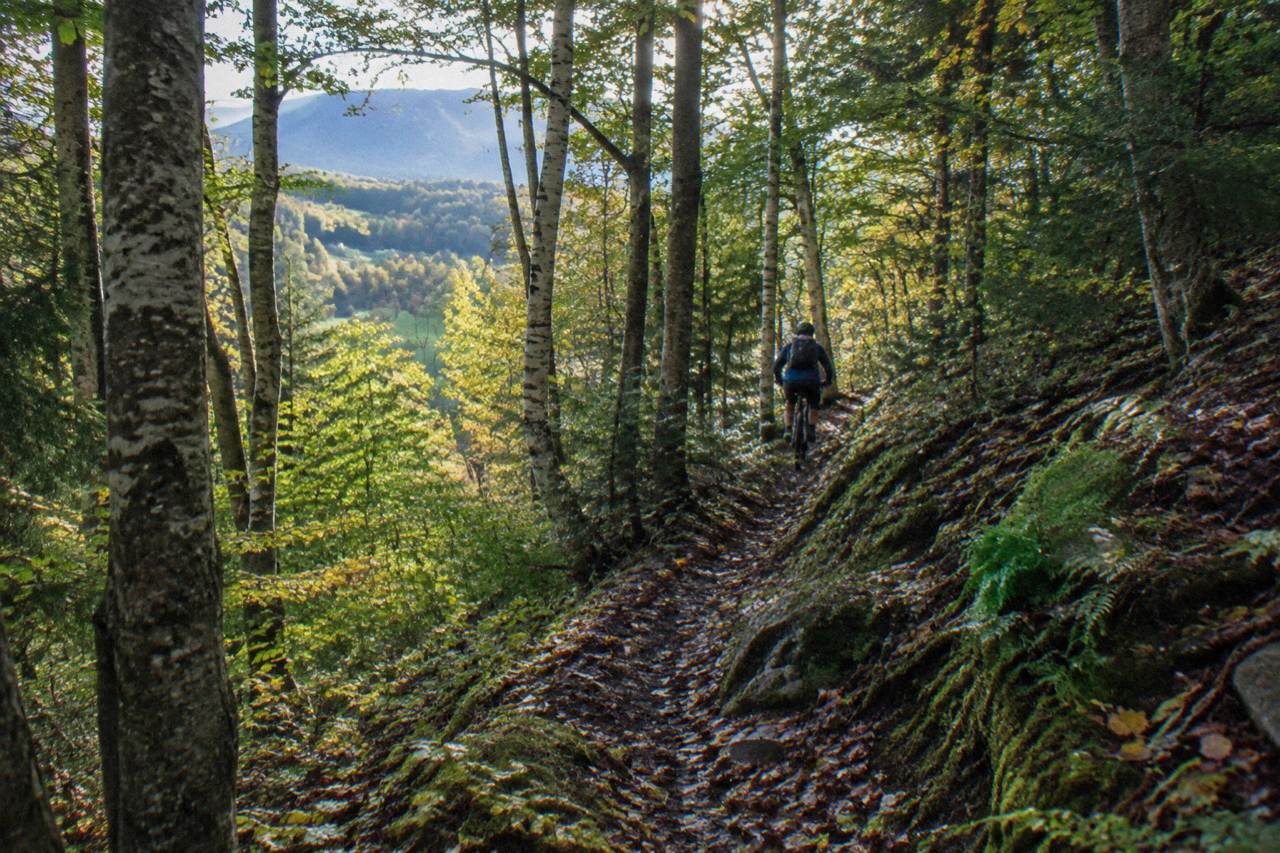
Vermont mountain biking runs on one big idea: the state is small, the hills are everywhere, and the trail networks sit close enough together that a single trip can sample three of them. The anchor is Kingdom Trails in East Burke, a network of 213 trails and more than 100 miles of non-motorized singletrack and multi-use trail in the Northeast Kingdom. From there the map spreads west and south: Stowe's village-side and mountain trails, the Mad River Valley around Waitsfield, the Killington area, and a scatter of smaller town networks maintained by local chapters of the Vermont Mountain Bike Association. This guide walks through where to ride, what each area suits, how the season works, and where to base a trip, with Vermont Biking Tours covering the road, rail trail and gravel side of the state elsewhere.
Kingdom Trails at East Burke is the center of mountain biking in Vermont: 213 trails and more than 100 miles of non-motorized singletrack and multi-use trail on private land, open when conditions allow from roughly May through late October. The network needs a pass, sold online through the Kingdom Trails Association store or at the Welcome Center on VT Route 114. Nothing else in the state, and little in the Northeast, matches its scale. For help planning your trip, our guide on where to find Vermont's best mountain biking covers lodging, timing, and other trail networks worth riding while you're in the area.
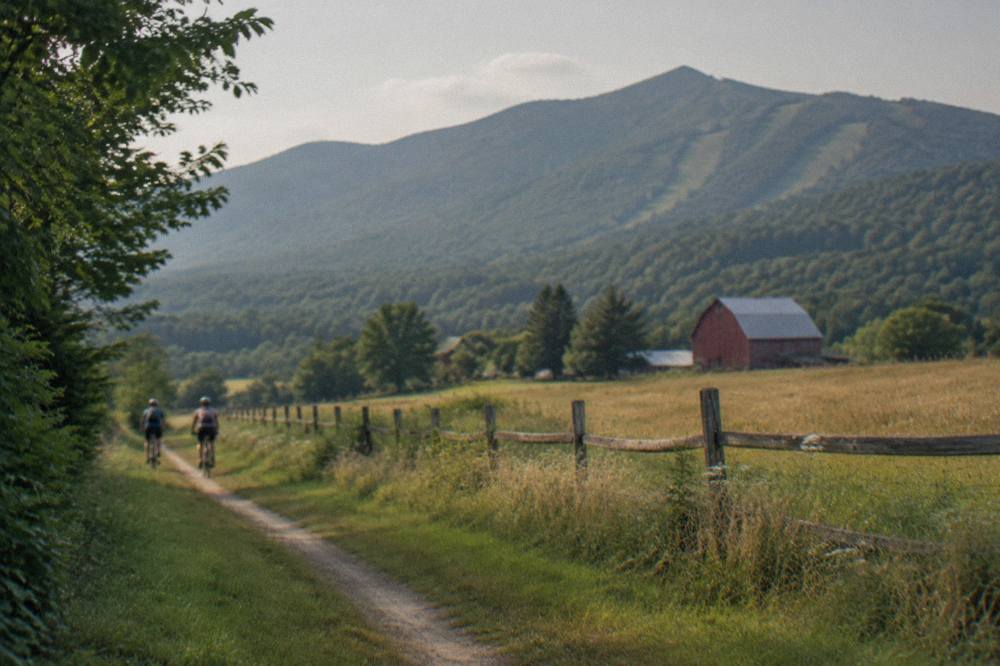
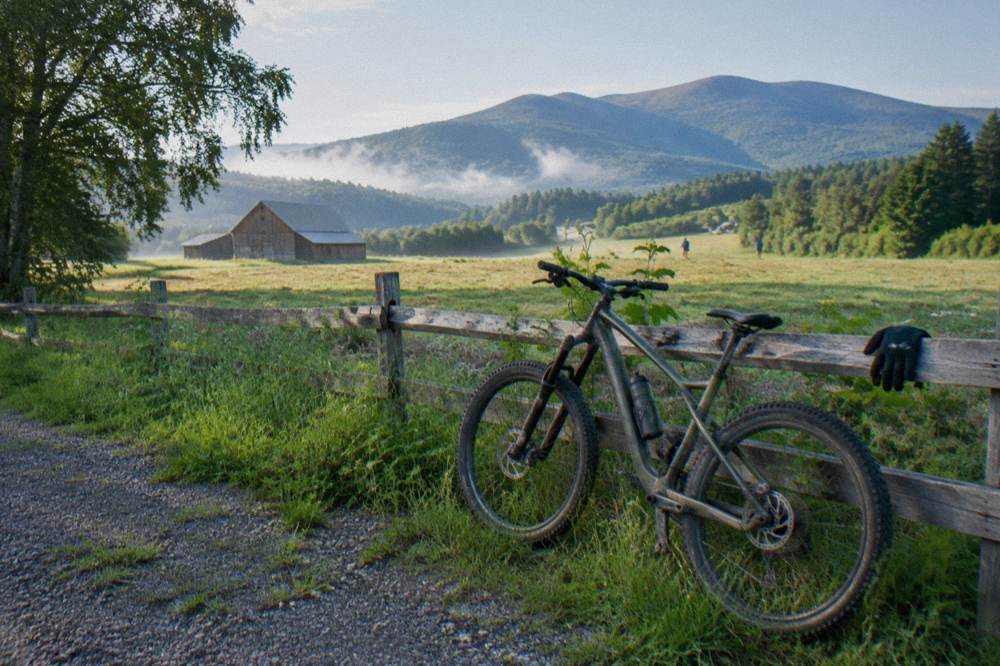
That scale comes with a specific character. Kingdom Trails is built on working farm and forest land, and the riding flows between pastures, barns and woods in a way that feels closer to a linked trail town than a bike park. Flow trails, machine-built berms and gentle green loops sit near technical root-and-rock descents, so a mixed group can ride from the same trailhead all day without anyone feeling punished. The association publishes a live trail map and conditions page, and riders should check both before committing to a long day, since rain closes sections to protect the surface.
The rest of the state divides into regional clusters, each with its own personality. Stowe pairs a recreation path through the village with mountain terrain on the slopes above. The Mad River Valley around Waitsfield and Warren offers steep, rooty riding in a valley famous for its foliage. Killington brings lift-served and gravity-oriented options into the mix. The chapters of the Vermont Mountain Bike Association, the statewide body that also tracks e-bike policy on state land, maintain and map many of the smaller networks, and their site is the first place to look when a trip heads somewhere new. For an overview of how these areas compare with the rest of the state's riding, see the Kingdom Trails mountain biking guide and the wider rundown of Vermont bike trails by difficulty.
East Burke suits everyone, from first-timers on green flow loops to expert riders chasing technical descents. Stowe and the Mad River Valley lean intermediate and up, with climbing and roots that reward fit riders. Killington's bike park serves gravity riders who want descending without the climb, while town networks like Middlebury's are gentle enough for families and riders rebuilding confidence before a bigger trip.
The honest way to choose is by how much climbing you want to earn. Kingdom Trails spreads its vertical across long, rolling routes, so the climbing feels distributed rather than punishing. The Mad River Valley is the opposite: short, steep climbs into dense hardwood, then descents that hold moisture and roots well into summer. Stowe sits between, with some lift and road access to higher trailheads and village-level paths below. Killington, as a resort, lets a rider buy a lift ticket and ride downhill laps all day.
| Area | Character | Best for | Watch out for |
|---|---|---|---|
| Kingdom Trails, East Burke | 100+ mi linked network, farm and forest terrain | All levels, groups of mixed ability | Pass required, check conditions page |
| Stowe | Village path plus mountain trails above | Intermediate riders wanting variety | Popular foliage weekends |
| Mad River Valley, Waitsfield area | Steep, rooty, technical | Fit intermediate and expert riders | Trails hold mud after rain |
| Killington | Lift-served, gravity focus | Downhill and jump-line riders | Resort operating calendar |
| Middlebury and town networks | Short loops close to town | Families and confidence building | Limited mileage per network |
First-time mountain bikers should read the Vermont bike tours for beginners and seniors page before committing to a full weekend, and anyone renting rather than hauling a bike should start with the guide to Kingdom Trails bike rentals and guided rides, which names the shops at the trailhead.
The main mountain bike season runs from when trails dry out, typically in May, to about the end of October, with the Kingdom Trails summer network closing for the season around October 31 before a winter fat bike network opens on designated trails. Late autumn closure protects the land and the deer hunting window. Midsummer brings the most reliable trail conditions, and late September to mid October adds peak foliage to the riding.
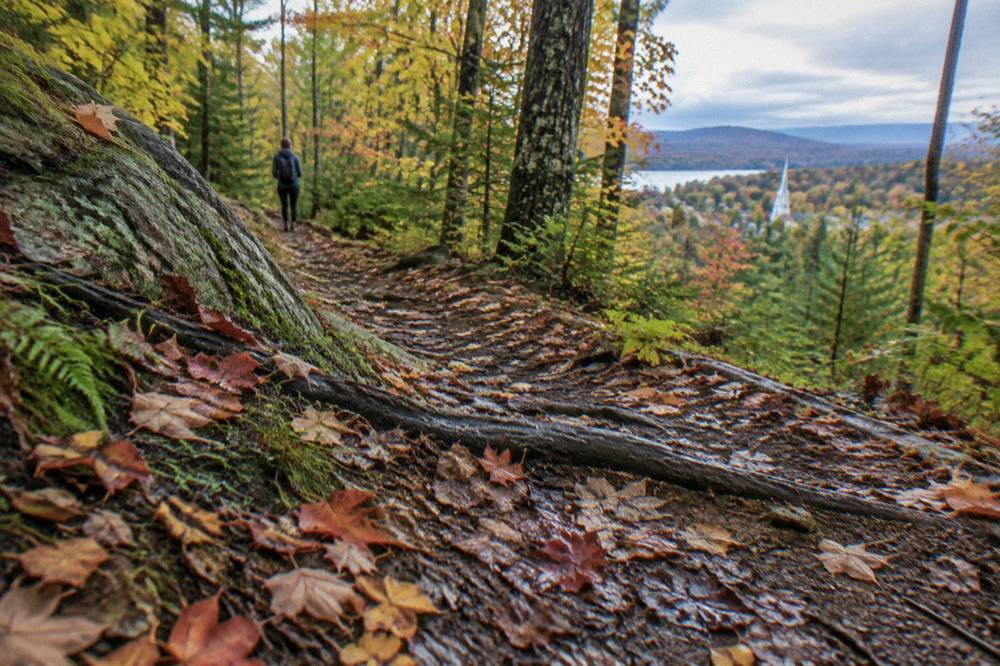
Each stretch of the season has a different argument for it. May can be muddy at lower elevations, and riders should respect closed signage rather than rutting soft trail. June through August is the high season: long daylight, dry surfaces, and the full network open, including the higher and more exposed trails that hold snow into spring. September shortens the days but thins the crowds once school restarts, and the foliage window, late September to mid October, turns a normal ride into something people plan whole trips around. Peak color moves across the state from the northern ridgelines, which turn first, to the southern valleys, which hold green the longest.
After the summer network closes, riding does not stop entirely. Kingdom Trails grooms designated singletrack for fat biking in winter, restricted to tires wider than 3.5 inches, and runs it alongside separate Nordic skiing and snowshoeing lanes, with fat bikes kept off the Nordic trails. The conditions page carries the winter status. Riders planning a foliage-season trip can pair this guide with the foliage peak dates by Vermont region to time the color to the riding.
Class 1 pedal-assist eMTBs are allowed on most Kingdom Trails trails, per the Kingdom Trails Association, with any landowner exclusions marked on the trail map. On state land the picture is narrower: e-bikes are currently prohibited on non-motorized natural-surface trails in Vermont state forests and parks, and allowed on roads and multi-use paths. Always check the specific network's rules before riding.
The split matters because so much Vermont singletrack sits on private or municipal land with its own agreements. Kingdom Trails' permission structure comes from dozens of landowners, which is why its e-bike policy is stated trail by trail rather than as a blanket rule. State land follows the state policy: multi-use paths and roads are open to compliant e-bikes, natural-surface mountain bike trails generally are not, and a proposed expansion of Class 1 access has not been confirmed as adopted. The Vermont Mountain Bike Association publishes the current state of that policy and is the reference point for riders with an eMTB.
Vermont's road law treats e-bikes as bicycles under a three-class system: Class 1 and 2 assist to 20 mph, Class 3 to 28 mph, with motors under 750 watts. But road law and trail permission are separate things, and a bike legal on a paved path can still be excluded from the singletrack next to it. Riders bringing a Class 2 or Class 3 bike to a mountain bike trip should expect more restrictions, not fewer. The full breakdown of where each class can ride is in the Vermont e-bike and helmet rules guide and the verdict on Vermont e-bike tours; the statewide picture is also covered in are e-bikes allowed in Vermont.
Yes. Kingdom Trails requires a pass for access, purchased online through the Kingdom Trails Association store or in person at the Welcome Center at 478 VT Route 114 in East Burke. Pass revenue pays the association's landowner and maintenance costs across the network. Current pass prices are not published as fixed figures here: check the association's store for the day, season and youth options before you go.
The pass system is the reason the network exists in its current form. Riding in East Burke crosses private farms and woodlots, and the association's lease and stewardship agreements depend on pass income. Buying one is not gatekeeping for its own sake, it is the mechanism that keeps 100-plus miles of trail open to the public. The Welcome Center also functions as the trailhead hub, with parking information, maps and staff who know which loops are riding well that day.
Riders should also understand the etiquette framework the association publishes. Trails close when wet, short cuts across switchbacks damage the surfaces, and dogs, hikers and horses share parts of the network. The shops around Burke, East Burke Sports at the trailhead, Kingdom Bike Rentals with its delivery and eMTB focus, Village Sport Shop and Rifugio Darling Hill, are good sources of same-day local knowledge, and the association's own pages at kingdomtrails.org carry passes, maps and conditions.
East Burke and Lyndonville put you closest to Kingdom Trails, with Stowe the natural base for its own trails plus the Mad Valley within reach, and Woodstock sitting well for central and southern networks. Choose by which trail system you plan to ride most: driving between regions eats riding time. Booking a room with free cancellation is smart in foliage season, when the best locations fill first.
For a Kingdom Trails trip, the practical question is how close to the trailhead you want to wake up. The riding is concentrated around East Burke and Darling Hill, and a base a couple of miles out keeps the morning shuttle short while avoiding trailhead-adjacent rates. The Wildflower Inn in Lyndonville sits 2.3 miles from Kingdom Trails, offers bike rentals and runs a bicycle shuttle for guests, which removes the daily parking question entirely. For riders who want the same proximity logic applied to the state's central networks, Sun & Ski Inn And Suites in Stowe sits right on the Stowe Recreation Path, and the Woodstock Inn & Resort in Woodstock village is the base for Woodstock's gravel loops and the Mount Tom carriage roads.
Lyndonville, 2.3 miles to Kingdom Trails
Offers bike rentals and a bicycle shuttle, and sits 2.3 miles from Kingdom Trails.
Check ratesStowe deserves its own paragraph here because it is the strongest second destination in the state. The village sits under the state's tallest mountain, the recreation path runs through the middle of town, and the mountain bike terrain above Mountain Road climbs into terrain that holds snow late and dries late. A Stowe base also puts the Lamoille Valley Rail Trail within reach for a recovery day: 95 miles of compacted crushed stone from St. Johnsbury to Swanton, the longest rail trail in New England, open year-round to non-motorized use with e-bikes allowed. The state's own trail pages at railtrails.vermont.gov carry surface details and the rules.
A guide or coach is worth it on a first visit to any large network, for riders learning technical skills, and for anyone on an eMTB who needs current trail-permission knowledge. Vermont has guide services attached to the main areas, including Vermont Mountain Bike Tours in the northern part of the state, and the shops at Kingdom Trails run guided and coached rides. Booking is done directly with the operator.
The case for a guide at Kingdom Trails is efficiency. A network of 213 trails has an internal logic, which loops connect, which climbs avoid traffic, which descents suit which skill, that takes visiting riders days to learn on their own. Local coaches also read trail conditions in a way a map cannot: after rain, the fast lines change, and a guide will route around the sections that are holding water. For beginners, a two-hour coached session before a weekend of riding usually does more for confidence than a week of solo guessing.
Beyond the shops, VBT Bicycling Vacations and Local Motion operate on the touring and path-riding side of the state rather than the singletrack side. Local Motion's Trailside Center at 1 Steele Street in Burlington rents conventional, Class 1 e-bike, adaptive and kids bikes right on the path, with reservations recommended, and its work covers the Burlington Greenway and Island Line Trail described in the Burlington bike path guide. VBT, at vbt.com, runs supported multi-day bike trips. Neither replaces a mountain bike coach, and riders wanting singletrack instruction should book with the mountain-side services named above.
Pack for mud, sudden weather and self-rescue: a helmet you will actually wear, flat-repair kit, water for three or more hours, layers for a temperature swing, and bug spray early in the season. Vermont trails hold moisture, so bring more cleaning and repair supplies than a dry-climate ride would need. Check the trail status before a long ride, since rain closes sections.
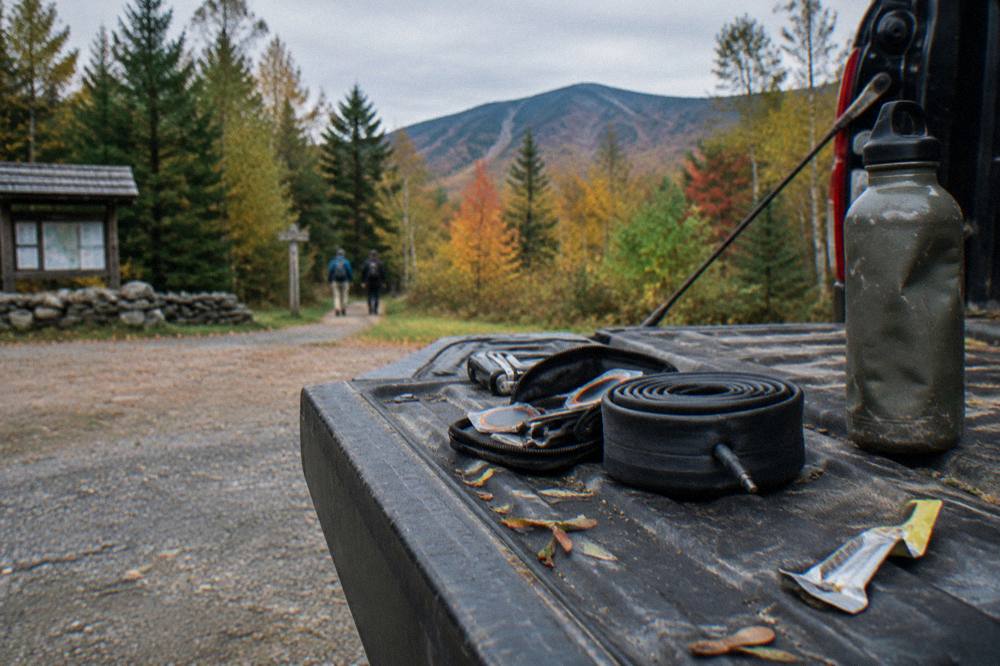
The list below is a planning range, not an operator promise, and riders should adapt it to the season and the length of the route.
| Item | Why it matters in Vermont | Season notes |
|---|---|---|
| Helmet | Head protection on rooty, rocky descents | All season |
| Tube, pump, tire levers, multi-tool | Root and rock strikes cause flats | All season |
| Water, two bottles or a pack | Climbing stretches between trailheads | Extra in July and August |
| Rain shell | Mountain weather turns fast | All season |
| Layers, arm and knee warmers | Morning chill even in summer valleys | Critical late September onward |
| Bug spray | Blackflies and mosquitoes near wet trails | Strongest in spring and early summer |
| Lights | Short foliage-season days | Late September to October |
Two Vermont-specific points deserve emphasis. First, mud is a trail-preservation issue, not just a laundry one: riding soft trail carves ruts that hold water and damage the surface, and networks including Kingdom Trails close sections after rain for exactly this reason. Second, October light is short, with sunrise near 7:00 and sunset near 6:20 in the foliage weeks, so a ride that starts late runs out of daylight quickly. The packing detail is covered more fully in what to bring on a Vermont bike tour.
Kingdom Trails is the outlier on scale at more than 100 miles; everything else in the state is a regional network measured in tens of miles. On season, all the summer networks follow the same May-to-late-October arc, with Kingdom Trails' winter fat bike network the main cold-weather option on groomed designated trails. Stowe and Killington add mountain-elevation terrain that opens later in spring.
The comparison table below pulls together what each system offers so a trip can be planned around one base rather than constant driving. Distances and season shapes come from the managing organizations; pass and rental pricing changes often enough that this table deliberately leaves it out.
| System | Scale | Season shape | Pass needed | E-bike access |
|---|---|---|---|---|
| Kingdom Trails | 213 trails, 100+ mi | Roughly May to late October, winter fat bike network after | Yes, online or at Welcome Center | Class 1 eMTB on most trails, check map |
| Stowe area networks | Regional, tens of miles | Late spring thaw to late October | Varies by land manager | Multi-use paths yes, singletrack varies |
| Mad River Valley | Regional, technical | Late spring to October | Varies by chapter | Check chapter rules |
| Killington bike park | Lift-served gravity | Resort operating calendar | Lift ticket | Check resort policy |
| Town networks, e.g. Middlebury | Short loops | Spring to fall, weather dependent | Usually no | Usually yes on multi-use paths |

One planning insight that first-page search results rarely state plainly: the networks cluster badly for driving. East Burke, Stowe and the Mad River Valley look close on a state map, but the mountain roads between them are slow, and a day that tries to ride two systems usually ends with more time in the car than on singletrack. The strongest Vermont mountain bike trips pick one base, ride its network properly, and save the second region for a return trip. Riders who want to mix disciplines rather than regions can pair singletrack days with the rail trail riding described in riding the Lamoille Valley Rail Trail or the Island Line, covered in biking the Island Line Trail. If you're still weighing whether the Green Mountain State earns a spot on your riding calendar, our honest assessment of Vermont as a mountain biking destination covers the season, the scale of the networks, and how the state stacks up against other bike trip options.
Stowe
A Stowe base for the Stowe Recreation Path and the road loops around the village.
Check ratesA note on the shoulder seasons, because they reward flexibility. The weeks either side of the main season, muddy May on the low networks and the cold edge of October, are when locals ride the most quietly: trailheads are empty, the foliage crowds have gone or not yet arrived, and the riding is at its most atmospheric. The trade is reliability, and that is what the trail conditions pages are for. Check status, check the weather, and go when both agree.
Kingdom Trails at East Burke, with 213 trails and more than 100 miles of non-motorized singletrack and multi-use trail, is the state's flagship network and one of the largest public mountain bike destinations in the Northeast. Stowe, the Mad River Valley and Killington round out the main options.
All levels. The network mixes gentle green flow loops with technical root-and-rock descents, so beginners, intermediates and experts can ride from the same trailhead. A pass is required, and the conditions page should be checked before a long day.
The summer networks open as conditions allow, typically in May, and close around the end of October, with Kingdom Trails' summer season running to about October 31. After that, Kingdom Trails grooms designated singletrack for winter fat biking with tires wider than 3.5 inches.
Class 1 pedal-assist eMTBs are allowed on most Kingdom Trails trails per the Kingdom Trails Association, with exclusions marked on the map. On state land, e-bikes are currently prohibited on non-motorized natural-surface trails and allowed on roads and multi-use paths.
Yes. Passes are bought online through the Kingdom Trails Association store or in person at the Welcome Center on VT Route 114 in East Burke. Check the association's store for current pass prices, since they change and are not fixed on this page.
East Burke and Lyndonville for Kingdom Trails, Stowe for its own networks and the recreation path, and Woodstock for the central and southern loops. Pick one base per trip rather than driving between regions, and book refundable rooms for foliage season.
Before you go, the pick for this guide:
The Wildflower Inn
Offers bike rentals and a bicycle shuttle, and sits 2.3 miles from Kingdom Trails.
Check rates →