Are E-Bikes Allowed On The Lamoille Valley Rail Trail?
Yes, e-bikes are allowed on the Lamoille Valley Rail Trail, Vermont's longest rail trail. Here is what the rules say, which classes are fine, where motorized machines are banned, and how to plan the ride.
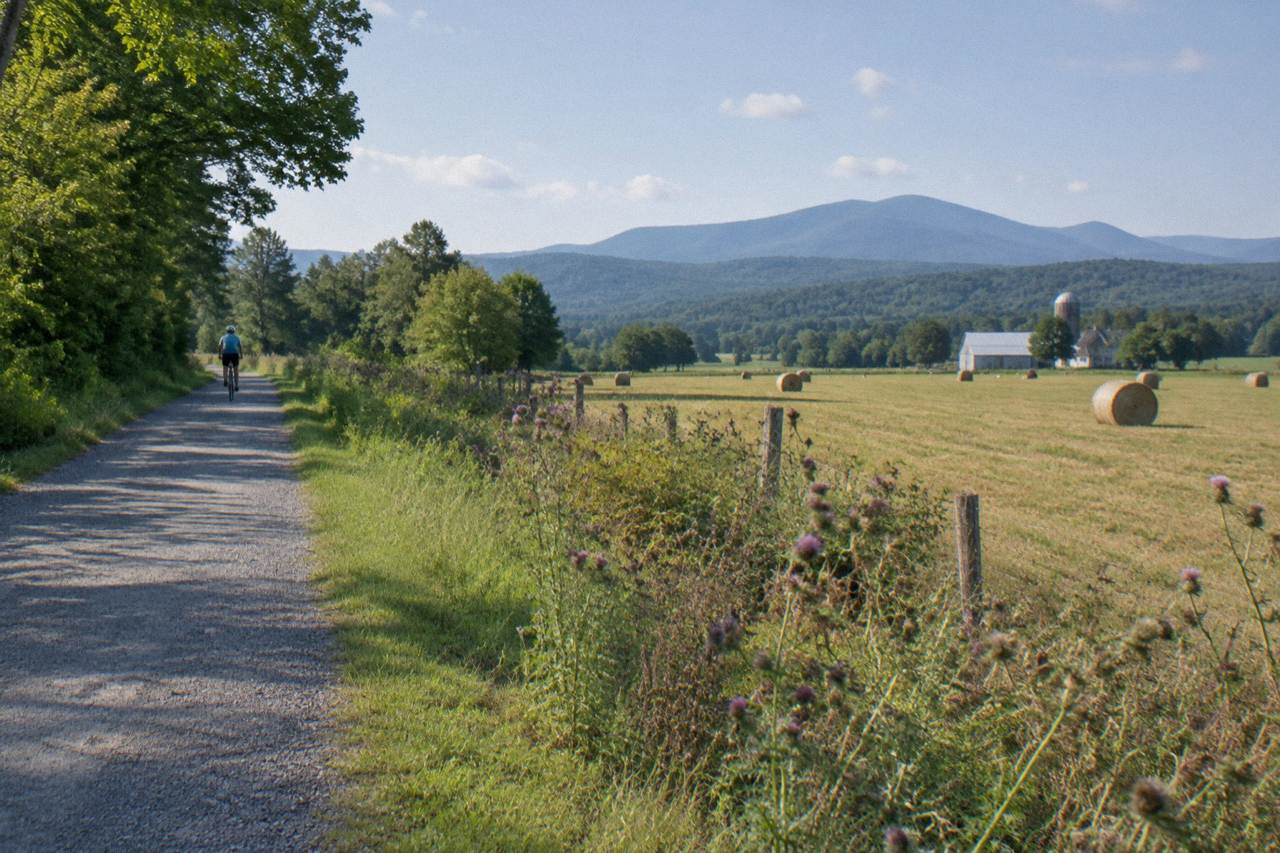
Yes, e-bikes are allowed on the Lamoille Valley Rail Trail. The official state trail pages state it directly: e-bikes are permitted, along with every other non-motorized use, on all 95 miles between Swanton and St. Johnsbury. What is not permitted are ATVs, dirt bikes, motorized scooters and similar machines, so the distinction that matters is pedal power with an electric assist versus a motor doing the work. Pedaling all ninety-something miles in one trip is a serious undertaking, but if you're curious how this route stacks up as Vermont's longest rail trail experience, the full breakdown covers everything you need to plan the ride.
That single distinction shapes everything else on this page. Riders arriving with a Class 1 pedal-assist bike, a throttle model, or a moped-style machine all face different answers, and the trail's managers draw the line by motor type and how the machine is used. This guide walks through the rule as published, what each e-bike class means in Vermont, where the exceptions live, and how to plan a riding day that takes advantage of the permission rather than testing it.
E-Bike Rules On The Trail
Yes, without a special permit or a separate lane. The state rail trail program's own pages for the Lamoille Valley Rail Trail list e-bikes among allowed uses, alongside walking, running, horseback riding, road bikes, mountain bikes and, in the designated season, snowmobiles. The trail is open year-round to non-motorized users, and an e-bike ridden as a bicycle falls on the permitted side of that line.
The wording matters because the trail is managed as a non-motorized corridor first. At 95 miles across 18 towns, it is the longest rail trail in New England, and its managers protect that character by excluding machines whose primary purpose is motorized travel. ATVs, dirt bikes, motorized scooters and segways are all named as prohibited. Snowmobiles are the one carve-out, limited to the winter season on the VAST network, from mid December to mid April.
An e-bike is treated differently because Vermont law treats compliant e-bikes as bicycles. A pedal-assist machine that meets the state's definitions does not need a license, registration or insurance, and it does not count as a motor vehicle for trail purposes. So the practical rule for the LVRT is simple: if it is legally a bicycle in Vermont, it is welcome on the rail trail.
Riders can verify the current language themselves on the official Vermont rail trails page, which carries the use rules and any trail updates worth knowing about before a long ride. Checking trail status before heading out is a good habit regardless, since flood repairs and maintenance happen across the network during the riding season.
What Counts As An E-Bike Under Vermont Rules?
Vermont uses a three-class system. Class 1 means pedal-assist only, with assistance cutting out at 20 mph. Class 2 adds a throttle, also limited to 20 mph. Class 3 is pedal-assist up to 28 mph, requires a speedometer, and has a minimum operator age of 16. All three classes must have a motor under 750 watts, and all three are legally bicycles rather than vehicles.
For trail riding, the class matters less on the LVRT than on some other Vermont terrain. The law treats Class 1, 2 and 3 alike as bicycles, and the rail trail's permission extends to e-bikes as a category. A rider on a Class 3 machine is welcome on the crushed stone surface just as a rider on an unassisted touring bike is, provided the machine meets the statutory definitions.
Where class distinctions bite harder is elsewhere in the state. On state-owned natural-surface trails, the current policy prohibits e-bikes on non-motorized singletrack, a rule the Vermont Mountain Bike Association tracks closely and that may evolve if a proposed expansion of Class 1 access is adopted. Rail trails sit in a different category entirely: they are multi-use paths, not backcountry trail networks, and multi-use paths are where e-bikes are clearly allowed.
The table below summarizes how the three classes are defined and where each stands on the Lamoille Valley Rail Trail.
| E-bike class | How it assists | Top assist speed | On the LVRT? |
|---|---|---|---|
| Class 1 | Pedal-assist only, no throttle | 20 mph | Yes |
| Class 2 | Throttle plus pedal-assist | 20 mph | Yes |
| Class 3 | Pedal-assist, speedometer required | 28 mph | Yes, rider 16 or older |
| Any class over 750 W | Falls outside the statutory definition | Varies | Treated as motorized, not permitted |
| ATVs, dirt bikes, scooters, segways | Motor driven | Varies | Prohibited |
One nuance worth knowing: a machine whose motor exceeds the statutory limit, or that is ridden primarily under throttle at high speed, can fall outside the bicycle definition altogether. Riders with powerful moped-style machines should not assume the e-bike label protects them. The trail rules, and the courtesy of everyone else on the path, both point the same way.
For a deeper look at how these rules play out across the whole state, including where e-bikes are restricted, the companion guide on Vermont e-bike and helmet rules covers the detail.
What Is The Lamoille Valley Rail Trail Actually Like To Ride?
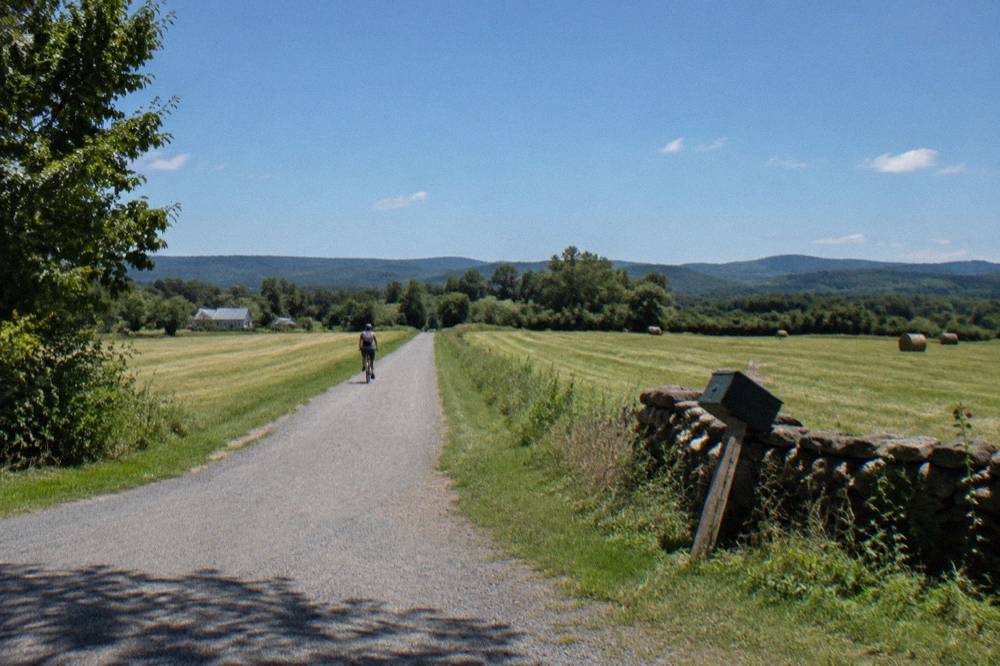
It is 95 miles of firm, compacted crushed stone, roughly 10 feet wide, with grass shoulders and grades under 3 percent for nearly the whole distance. The trail runs from Swanton near Lake Champlain to St. Johnsbury in the northeast, through 18 towns, on a former rail bed whose gentle engineering makes it one of the most approachable long rides in the region.
The surface is the headline fact for e-bike riders. Because the grade never steepens beyond what a train could climb, the trail asks very little of legs or batteries. A rider on a Class 1 bike with a modest battery can cover long distances at a relaxed assist level, and the crushed stone surface is firm enough for road-style tires wider than about 40 mm, though fatter tires ride more comfortably.
The accessibility of the grade is also why the trail is popular with riders who would not describe themselves as cyclists at all. The rail bed was engineered for freight, so the climbs are long and gentle rather than sharp, and the whole corridor is considered wheelchair accessible, which tells you how manageable the surface and gradient are.
Distance planning deserves a paragraph of honesty. Ninety-five miles is a committed ride even with assistance, and most visitors ride it in sections, using towns like Jeffersonville, Cambridge, Hyde Park, Morrisville, Hardwick, Danville or Lyndonville as start and finish points. Food and water exist in the towns, not on the trail itself, so a water bottle plan matters more on this trail than on a greenway with fountains every mile.
Where Should You Stay For An E-Bike Trip On The Trail?
The smart approach is to base in one of the trail towns and ride out-and-back sections, or to move between two bases for a multi-day trip. Lyndonville in the east puts you minutes from the trail with a bike-friendly inn nearby, Morrisville and Hardwick sit mid-trail, and the Swanton end pairs the trail with Lake Champlain riding. Because the trail is linear, a single base serves an out-and-back day perfectly.
Lyndonville is the standout eastern base for reasons beyond the trail itself. The Wildflower Inn there offers bike rentals and a bicycle shuttle. Ask the inn what the shuttle covers before you plan a linear ride on the rail trail. The inn sits in the Northeast Kingdom, close enough that a rest day can be spent at the Kingdom Trails mountain bike network in East Burke rather than on the rail trail.
In that same spirit, The Wildflower Inn in Lyndonville works as a genuine riding headquarters, with bike rentals and a bicycle shuttle, 2.3 miles from Kingdom Trails. Riders whose trips are centered on the western end have a different set of options. Burlington is not on the trail, but it is the region's lodging hub, and Hotel Champlain Burlington, Curio Collection by Hilton sits steps from Waterfront Park and the bike path access there, with bicycle rentals listed on its page, which suits a trip that combines a Burlington greenway day with a driving start on the LVRT.
The comparison below matches bases to riding styles.
| Base town | Trail access | Best for |
|---|---|---|
| Lyndonville | Eastern section | Multi-day rides, Kingdom Trails rest days |
| Morrisville / Hyde Park | Mid-trail | Splitting the 95 miles into two out-and-back days |
| Hardwick | Mid-trail | A quiet town base with food and water close to the corridor |
| Jeffersonville / Cambridge | West-central | River scenery and valley riding |
| Swanton | Western terminus | Pairing the trail with Lake Champlain area rides |
Stowe also deserves a mention as a secondary base, since the Stowe Recreation Path and the road loops around the village make a strong contrast day to rail trail riding, and the town is a reasonable drive from the mid-trail sections.
The Wildflower Inn
Lyndonville, 2.3 miles to Kingdom Trails
Offers bike rentals and a bicycle shuttle, and sits 2.3 miles from Kingdom Trails.
Check ratesWhere Are E-Bikes Not Allowed In Vermont?
The main exclusion is state-owned natural-surface trail, where current policy prohibits e-bikes on non-motorized singletrack while permitting them on roads and designated multi-use paths. The restriction does not touch rail trails, which are multi-use paths by definition. Privately managed networks set their own rules, and one of the best known, Kingdom Trails, allows Class 1 pedal-assist eMTBs on most of its trails.
This is the point where riders conflate different kinds of riding and get confused. Someone who heard that e-bikes are banned on some Vermont trails may assume the LVRT is included, when in fact the ban conversation is about backcountry singletrack on state land, a completely different setting. The Vermont Mountain Bike Association publishes the state of that policy, including a proposal that would expand Class 1 access, and its page at vmba.org is the reliable place to follow it.
For riders combining the rail trail with a mountain bike day, Kingdom Trails in East Burke is the regional heavyweight, with more than 100 miles of non-motorized singletrack and multi-use trail across a network of over 200 named trails. Its rule is Class 1 pedal-assist eMTBs on most trails, with the trail map showing any landowner exclusions, and riders should check the map rather than assume every trail is open to assist. Passes come from the Kingdom Trails Association store or the Welcome Center on Route 114 in East Burke, and current pass prices are listed there rather than in third-party summaries. The association's site, kingdomtrails.org, carries the trail map and conditions.
Rental shops in the Burke area, including East Burke Sports, Kingdom Bike Rentals, Village Sport Shop and Rifugio Darling Hill, stock e-MTB options alongside conventional bikes, which tells you how normal assisted riding has become in that part of the state. More of these guides are collected on Vermont Biking Tours.
How Fast Can You Ride, And What Etiquette Applies?
Vermont's class system caps assist at 20 mph for Class 1 and 2 bikes and 28 mph for Class 3, and those caps describe assistance, not a license to ride at those speeds on a shared path. The LVRT is a multi-use corridor with walkers, runners, horses and children, so practical riding speed is set by sight lines, traffic and courtesy rather than by what the motor will do.
Rail trail etiquette follows a familiar pattern, and e-bike riders carry a slightly heavier share of the responsibility because their machines are quiet and faster than most people expect. Call out or ring a bell well before passing, pass at a walking-pace differential when the trail is busy, and slow right down through trailhead zones and bridge crossings. Horses are present on parts of this corridor, and a startled horse is a genuine hazard, so stop and speak calmly rather than rolling past.
A few habits keep an assisted rail trail day pleasant for everyone:
- Ride predictably and hold your line, especially on curves where the stone surface can be loose at the edges.
- Give horses a wide, slow passage, verbal first, and wait for the rider's cue.
- Keep speeds low near the 18 towns' trailhead crossings, where foot traffic concentrates.
- Take battery range seriously on the remote middle sections, where towns are several miles apart and a flat battery turns an assisted rider into a tired one.
The speed question also touches legality off the trail. Vermont law requires drivers passing cyclists to leave generous clearance, and cyclists riding on narrow rural roads, which you will use to reach many trailheads, should ride as far right as is safe. Neither point changes the rail trail rules, but both matter on a day that mixes path and road.
Do You Need A Helmet, Permit Or Insurance For An E-Bike There?
No permit, license, registration or insurance is required for a compliant e-bike anywhere in Vermont, including the LVRT, because the law classifies these machines as bicycles. Helmet rules are the one place to be careful with specifics, since the state's helmet statute details are easy to get secondhand and wrong, so the sound advice is simply to wear one on every ride.
This site deliberately avoids repeating a helmet-law age figure, because the commonly circulated numbers have not been verified against the statute text, and an incorrect age claim is worse than no claim. What can be said plainly: helmets dramatically reduce head injury risk, they are standard practice among Vermont riders, and any rental shop will expect you to wear one with their bike. If you need the statute language for a specific situation, the Vermont statutes are the primary source.
Insurance and permitting questions almost always come from riders whose machines sit near the boundary of the e-bike definition. A compliant Class 1, 2 or 3 bike under 750 watts needs nothing beyond what a bicycle needs. A machine over that limit, or one built primarily for throttle travel, may fall into motor vehicle territory, where different rules apply entirely. If your machine is genuinely borderline, the safe assumption is the stricter one.
For a fuller treatment of the rules, including where e-bikes face limits in the state, see road, gravel and e-bike riding compared in Vermont, and for planning around the machines themselves, the guide to Vermont e-bike tours covers what operators offer.
What Is The Best Season And Section For An E-Bike Ride?
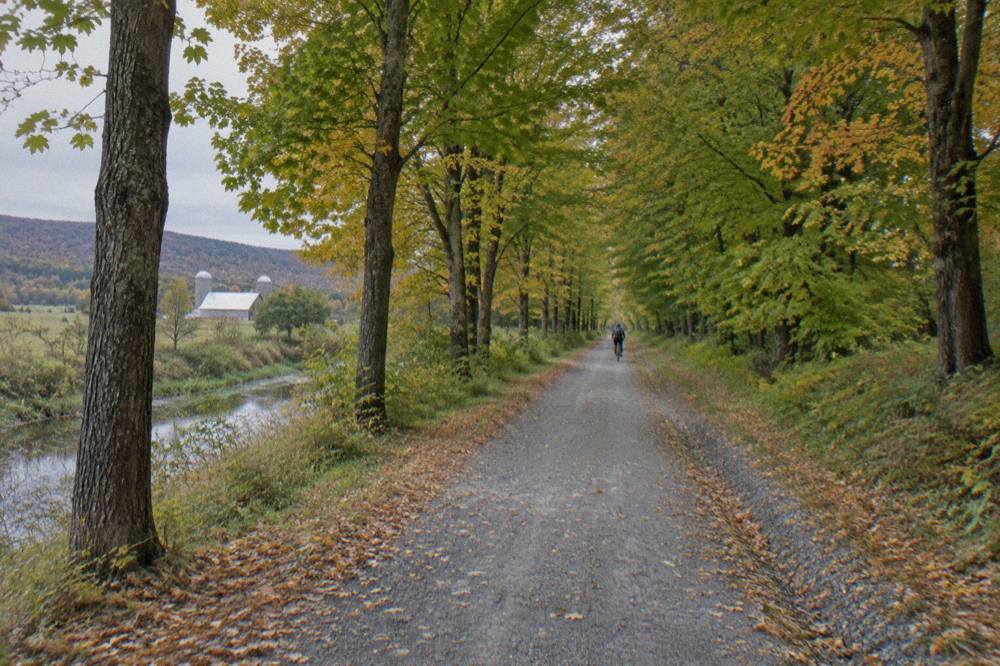
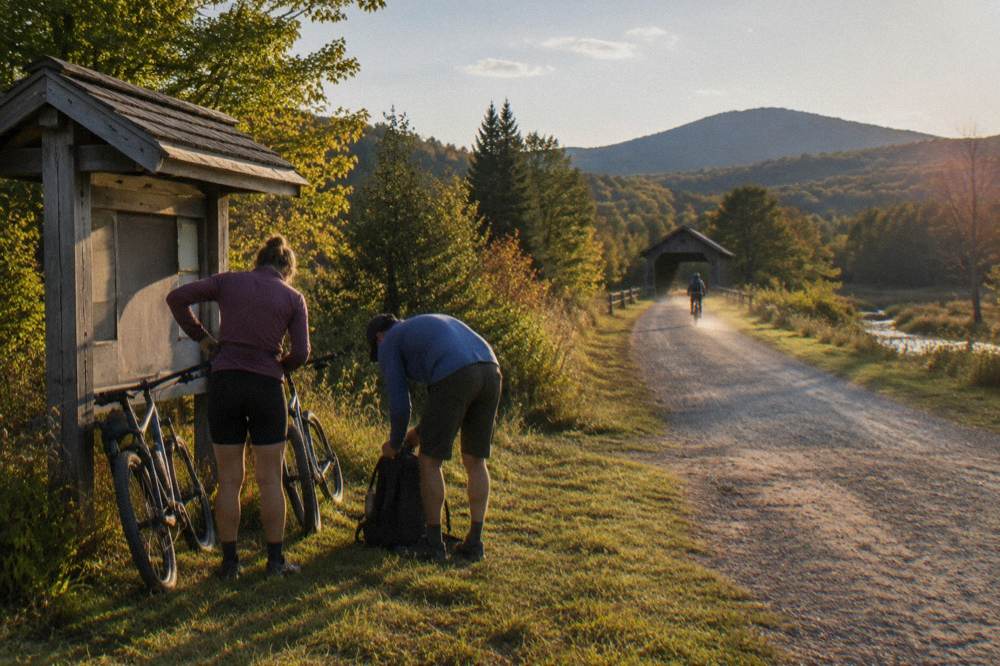
Late spring through mid October is the riding window, with the foliage period from late September to mid October the most spectacular and the most popular. Northern sections peak earliest and the valleys hold color latest, and October days average highs in the mid 50s with overnight lows in the mid 30s, so morning riders want layers and lights matter as sunset slides toward early evening.
Section choice depends on what you want from the day. The middle sections between Jeffersonville and Hardwick deliver the classic Vermont mix of river, farmland and village, with enough towns to resupply. The eastern end around Lyndonville and St. Johnsbury is quieter and pairs well with a Northeast Kingdom itinerary. The western end near Swanton connects toward the Missisquoi Valley Rail Trail for riders who want to add another car-free corridor to the trip. If you're still weighing which stretch fits your plans, the section by section comparison of the Lamoille Valley Rail Trail covers scenery, town services and half day ride options in detail.
Foliage season changes the calculus in two ways. Color makes the corridor extraordinary, and leaf-peeper traffic makes the access roads busier, especially around the scenic driving routes. Midweek riding in October is noticeably calmer than weekends. Trail conditions in the fall are usually at their best, firm and dry after summer settling, though a wet week can soften the shoulders, and the standing advice applies: check trail status before a long ride, because maintenance and occasional detours are part of life on a 95-mile corridor.
Riders who fall for the trail often graduate to other assisted riding in the state, and the question of where to bike in Vermont has a longer answer than any single corridor can give. Burlington's lakefront path and the causeway ride toward the Champlain Islands make a strong western companion, with one caveat that matters for planners: the seasonal bike ferry across the causeway gap runs late May to mid October and is closed outside that window, so a full causeway crossing needs the ferry or a turnaround. Local Motion's page at localmotion.org carries the current status and rental information from its Trailside Center on the Burlington path.
Sun & Ski Inn And Suites
Stowe
A Stowe base for the Stowe Recreation Path and the road loops around the village.
Check ratesWhat Should You Pack For A Rail Trail E-Bike Day?
A charged battery plus a spare or a charger, two water bottles, flat repair supplies that fit your bike, layers for morning chill, and lights if the day might run long. The LVRT's remoteness in its middle sections is the honest reason for the list: towns are several miles apart, cell coverage varies, and a mechanical problem far from a trailhead is a long walk on crushed stone.
Battery planning deserves the most thought. Assist levels drain batteries very differently, and headwinds on the open farm sections can quietly double consumption. A rider planning a 50-mile out-and-back should either carry a second battery, plan a lunch stop with an outlet, or ride a lower assist level and accept a steadier pace. Charging opportunities exist in every town with a cafe, and most cafe owners are tolerant of a polite charging request with a purchase.
Repair supplies for an e-bike are the same as for any bike, with two additions: know how to power the motor off and remove the battery, because both affect how the bike handles a walk-home scenario, and know that a rear flat on a hub-motor bike is more fiddly than on a conventional one. Tire sealant in the tires before the trip prevents most of the problem outright.
| Item | Why it matters on the LVRT |
|---|---|
| Spare battery or charger | Middle sections are remote and assist drains faster into headwind |
| Two water bottles | Towns are miles apart on the farm corridors |
| Tube, pump, levers, sealant | Crushed stone edges can puncture; hub-motor flats are slower to fix |
| Layers and light gloves | October mornings near freezing, afternoons in the 50s |
| Lights | Fall sunset is early and tree cover darkens the corridor quickly |
| Downloaded map or trail app | Cell coverage varies across the 95 miles |
For a fuller checklist aimed at Vermont riding conditions generally, what to bring on a Vermont bike tour goes into detail, and much of it applies to a self-planned rail trail day just as it does to an operator-run trip.
Vermont Biking Tours exists as a guide to riding like this: corridors where an e-bike is genuinely welcome, towns that reward stopping, and rules clear enough to plan around. The Lamoille Valley Rail Trail is close to the ideal case, a trail whose managers looked at pedal-assist riding and said yes, plainly, on the official page. Ride it with a charged battery, a slow bell, and time to stop in the towns along the way.
Common Questions About E-Bikes On The Lamoille Valley Rail Trail
Are E-Bikes Allowed On The Lamoille Valley Rail Trail?
Yes. The official state rail trail pages list e-bikes among the permitted uses on all 95 miles, treating compliant machines as bicycles. ATVs, dirt bikes, motorized scooters and segways are prohibited, and snowmobiles use the corridor only within the winter season.
Are Throttle E-Bikes Allowed, Or Only Pedal-Assist?
Both Class 1 pedal-assist and Class 2 throttle e-bikes meeting the state definitions are allowed, since Vermont treats all three compliant classes as bicycles. Machines that fall outside the definitions, including anything over the 750 watt motor limit, may be treated as motorized and are not permitted on the trail.
Is There An Age Limit For Riding An E-Bike On The Trail?
State law sets a minimum operator age of 16 only for Class 3 pedal-assist bikes, the 28 mph category. Younger riders may be passengers on bikes designed to carry them. There is no trail-specific age rule beyond what state law sets for the machine being ridden.
Do I Need A Pass Or Permit To Ride The Lamoille Valley Rail Trail?
No pass or permit is required for the rail trail itself, which is open to non-motorized uses year-round. That is different from networks like Kingdom Trails, where passes are required and bought through the Kingdom Trails Association store or the Welcome Center in East Burke.
Where Can I Rent An E-Bike Near The Trail?
Rental availability is strongest in the population centers at each end and in the Northeast Kingdom around Burke and Lyndonville, where shops including East Burke Sports, Kingdom Bike Rentals, Village Sport Shop and Rifugio Darling Hill rent e-MTBs and conventional bikes. Check current rental prices directly with the shops, since they change seasonally.
What Surface Should My Tires Handle?
The trail is firm compacted crushed stone about 10 feet wide with grass shoulders, so most tire widths work, though wider tires ride more comfortably on long distances. The grade stays under 3 percent nearly throughout, which is why the corridor is popular with e-bike riders and riders new to longer distances alike.