Hotel Champlain Burlington, Curio Collection by Hilton
Burlington, near Waterfront Park
Steps from Waterfront Park and the bike path access; its listing includes free bicycle rentals.
Check ratesVermont's reputation rests on its hills, and hills are exactly what an e-bike flattens. Here is how the state's e-bike rules work, where pedal-assist bikes are welcome, what battery range really means on a climb, and who rents the bikes.
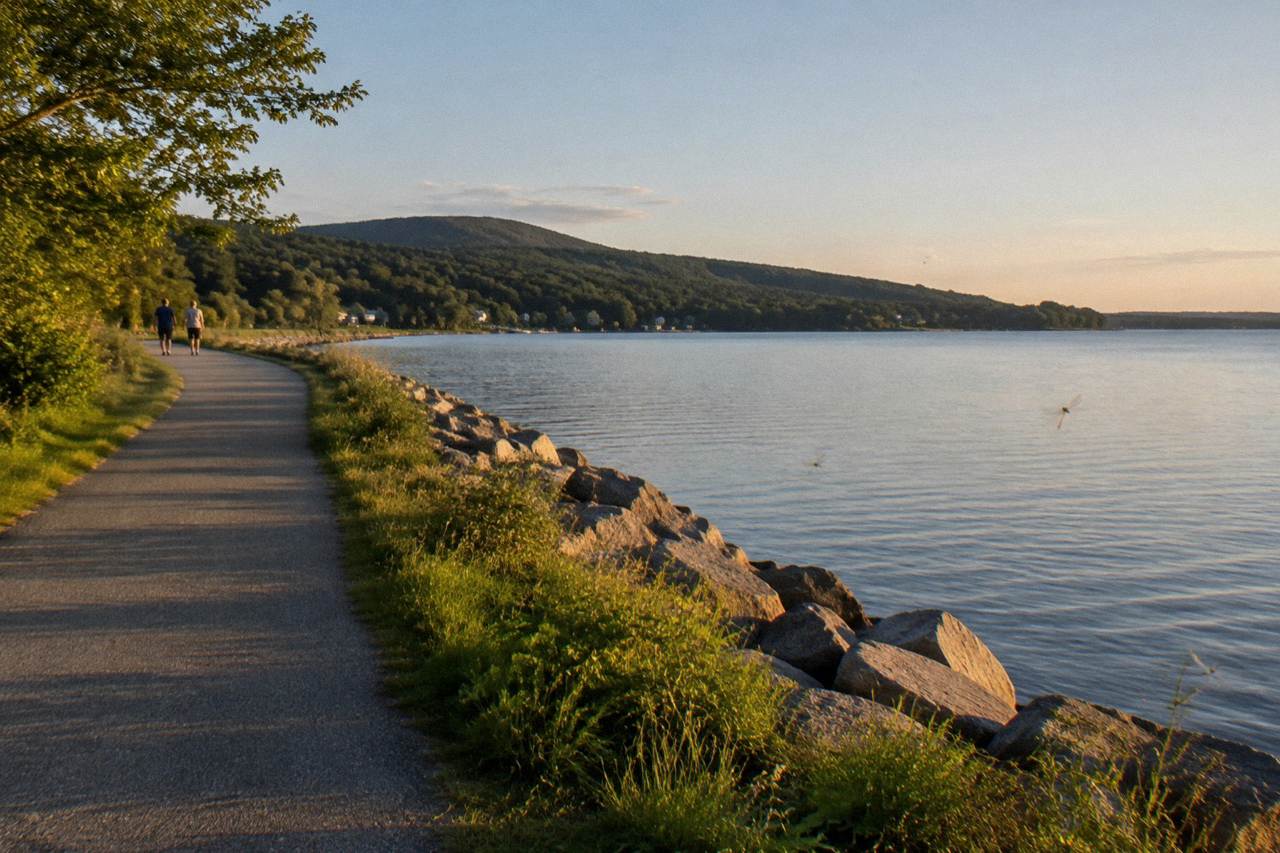
Short answer
E-bikes are legal in Vermont under a three-class system and are treated as bicycles. Class 1 pedal-assist bikes are allowed on the Lamoille Valley Rail Trail, the Island Line Trail and most Kingdom Trails trails. E-bikes are not allowed on natural-surface trails on state land. Local Motion in Burlington and several Burke shops rent them.
Vermont is a state that rewards pedaling and punishes the unprepared. The same Green Mountains that make the scenery also make the climbs, and a ordinary road loop around Stowe or a gravel lane outside Woodstock can stack hundreds of feet of gain into a handful of miles. That is the honest case for an e-bike: not cheating the hills, but negotiating with them. For riders who want the view without arriving at it wrecked, a pedal-assist bike changes which parts of Vermont feel open.
This guide covers the practical side. Vermont law puts e-bikes in three classes and treats them as bicycles, which matters because access then follows the bike, not a separate license. Where the classes diverge is on trails: a Class 1 pedal-assist bike is welcome on the Lamoille Valley Rail Trail, the Island Line Trail and most of Kingdom Trails, while e-bikes of any class are kept off natural-surface trails on state land. Battery range, hills and charging shape the daily plan more than distance does. And rentals are concentrated in a handful of places, led by Local Motion's Trailside Center on the Burlington waterfront.
An e-bike tour in Vermont is a self-guided or guided riding trip on a pedal-assist bike rather than a purely human-powered one, and it suits riders who want Vermont's climbing without paying for it in legs: older riders, mixed-fitness groups, anyone recovering from injury, and photographers who would rather look up than grind. Several operators build trips around them and rental shops supply them. The trips themselves look like any other Vermont riding: a rail trail day on the Lamoille Valley Rail Trail, a lake-shore spin out the Island Line Trail, a singletrack weekend at Kingdom Trails with an eMTB under you. What changes is the ratio of effort to elevation. A rider who can comfortably do 25 flat miles can suddenly do 40 hilly ones, which in a state where almost nothing is flat is the difference between a good day and a long one.
The format spans everything from a two-hour afternoon rental to a week-long inn-to-inn trip. Some riders book through an established operator such as VBT Bicycling Vacations, which runs supported trips where luggage moves ahead of you and an e-bike can often be requested for the riding days. Others build the same thing from parts: a rental bike, a base town, and a loop ride each day. Both count. The term tour here describes the shape of the trip, not a product this site sells, and every booking goes through the operator or shop directly.
Who does not suit one? Riders chasing fitness, mostly, and strong climbers who would find the motor redundant on the grades Vermont actually serves up. There is also a discipline question: a pedal-assist bike only helps while you pedal, so it is a multiplier on effort rather than a replacement for it, and riders expecting a moped experience are looking at the wrong machine and, in most trail settings, an illegal one.
Vermont's riding is defined by short, repeated climbs: backroads rise and fall constantly, and popular routes stack serious elevation into modest mileage. A Class 1 pedal-assist motor, capped at 20 mph of assistance, flattens the steepest pitches into something rideable at a steady cadence, which turns intimidating route options into ordinary ones and keeps groups of mixed fitness together. The numbers explain the state's reputation. Rural Vermont roads are frequently narrow with limited or no shoulders, and the terrain does not relent: a loop that reads as 30 miles on the map can carry several thousand feet of gain. October riding adds cool mornings and evenings, with average highs around 56F and lows around 36F, so a climb that warms you up is welcome but a day of them wears.
The assist changes the math at the bottom of a hill. Instead of choosing the gear that survives the grade, the rider chooses the cadence that feels good and the motor fills the gap up to its cutoff. On the steep pitches around Stowe's Mountain Road or the pitched lanes of the Northeast Kingdom, that is the difference between arriving at the top talking and arriving at the top silent. Group dynamics improve for the same reason: a slower climber on a pedal-assist bike keeps pace with a faster climber on a regular one, and nobody spends the day waiting.
The honest trade-off is weight and range. An e-bike carries a motor and battery, which makes it heavier to load onto a car rack and heavier to pedal once the battery runs out. Range management, covered below, becomes part of trip planning in a way it never is on a regular bike. And the assistance is capped, so descending is identical, which in Vermont means fast, shaded and occasionally gravel-strewn.
Vermont uses a three-class e-bike system and treats compliant e-bikes as bicycles: no license, registration or insurance. Class 1 and Class 2 bikes assist up to 20 mph, Class 3 up to 28 mph with a minimum operator age of 16, and motors must be under 750 watts. The class determines where a bike can go, so the label on the frame matters on every trailhead sign. The framework, adopted under the state's Act 40, aligns Vermont with the majority of states. Class 1 is pedal-assist only, with no throttle. Class 2 adds a throttle limited to the same 20 mph. Class 3 is pedal-assist to 28 mph, requires an operating speedometer, and cannot be ridden by anyone under 16. Because all three are legally bicycles, they ride on roads and paths where bicycles are allowed, subject to the local exceptions that follow in the next section.
| Class | Assistance | Top assisted speed | Throttle | Minimum operator age | Notes |
|---|---|---|---|---|---|
| Class 1 | Pedal-assist only | 20 mph | No | None set by class rules | Widest trail access, including rail trails and most Kingdom Trails singletrack |
| Class 2 | Pedal-assist or throttle | 20 mph | Yes | None set by class rules | Motor over 750 watts makes it something else entirely |
| Class 3 | Pedal-assist only | 28 mph | No | 16 | Requires speedometer and label; road-oriented |
Two cautions keep this honest. Vermont's helmet requirement for younger riders sits in statute that this site has not verified line by line, so the advice here is simply to wear one, always, on any bike. And the rules around e-bikes on state land are actively evolving: the Vermont Mountain Bike Association publishes the current position, and a proposed policy to expand Class 1 access on state forests and parks had not been confirmed as adopted. The Vermont Mountain Bike Association page on pedal-assist riding is the place to check before assuming access.
One more practical note for renters: Local Motion, which rents Class 1 e-bikes on the Burlington waterfront, restricts its rental e-bikes to riders 18 and older, or 16 and older with a guardian along. Private shops set their own policies, so ask at the counter rather than assuming.
Class 1 e-bikes are allowed on the Lamoille Valley Rail Trail and the Island Line Trail, treated exactly as bicycles, and on most Kingdom Trails singletrack per the Kingdom Trails Association. E-bikes are prohibited on non-motorized natural-surface trails on state land, and throttle-driven e-motos are banned from paths statewide. In practice, a Class 1 pedal-assist bike is the machine that opens the whole state. The clearest statement comes from the rail trail authority: e-bikes are allowed on the 95-mile Lamoille Valley Rail Trail, which runs from St. Johnsbury to Swanton through 18 towns and is the longest rail trail in New England. All non-motorized uses are permitted there year-round, while ATVs, dirt bikes, motorized scooters and similar machines are not, and snowmobiles use the corridor only in their designated winter season.
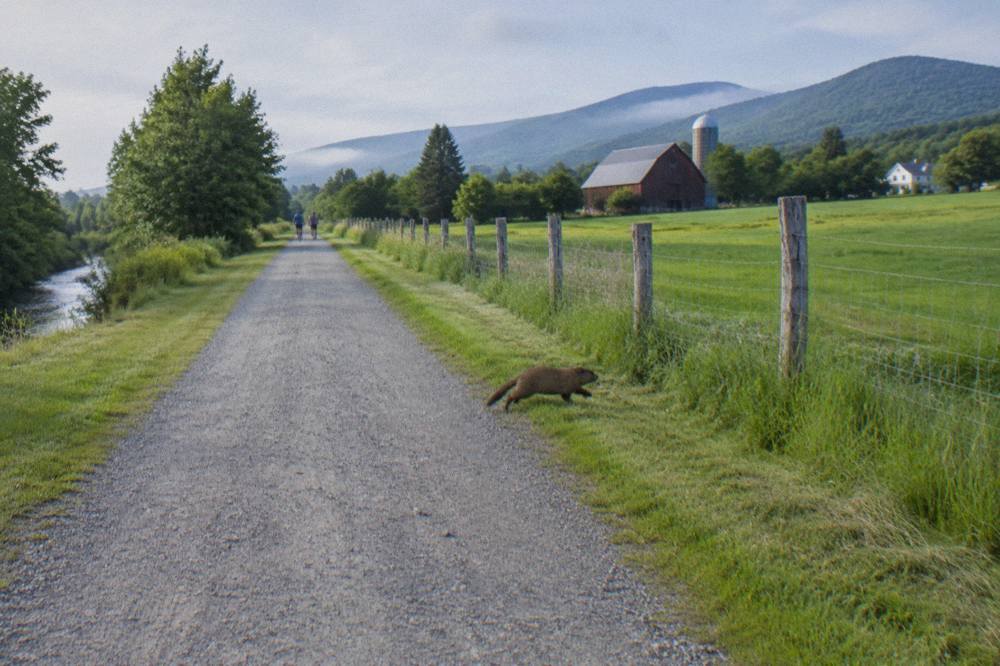
The Island Line Trail out of Burlington follows the same logic on a lake: about 14.4 miles from the Burlington waterfront to South Hero, with roughly 8 paved miles of Burlington Greenway and about 5 miles of crushed gravel on the Colchester Causeway. Class 1 pedal-assist bikes are permitted where bicycles are allowed, and the path's flat grade means battery drain is minimal anyway.
| Riding area | E-bike access | Governing rule | Best bike |
|---|---|---|---|
| Lamoille Valley Rail Trail | Allowed, all compliant classes | State rail trail rules; ATVs and scooters prohibited | Any e-bike; surface is compacted stone |
| Island Line Trail and Burlington Greenway | Allowed | City path rules; e-motos prohibited | Any e-bike; watch for walkers in town |
| Kingdom Trails | Class 1 pedal-assist eMTB on most trails | Kingdom Trails Association; check the map for landowner exclusions | Class 1 eMTB only |
| State land natural-surface trails | Prohibited for e-bikes | Vermont Forests, Parks and Recreation; policy under review | Leave the motor at home |
| State park roads and multi-use paths | Allowed | Same framework as bicycles | Any compliant e-bike |
Kingdom Trails is its own category, with access governed by the private landowner agreements behind the network rather than state law. The Kingdom Trails Association states that Class 1 pedal-assist eMTBs are allowed on most of the network's trails, with exclusions possible on specific parcels, so the current trail map is the final word. The Kingdom Trails Association site carries the map, trail status and pass purchasing. Riders planning around the state-land prohibition can lean on the networks above, plus town paths like the Stowe Recreation Path, which is exactly the kind of flat, scenic corridor where an e-bike is almost superfluous and always welcome. For a wider look at how the formats compare, see our road, gravel and e-bike comparison, and for the legal fine print, the Vermont e-bike and helmet rules guide.
There is no single honest range number: assist level, rider weight, climbing and temperature all move it, and Vermont serves all four in quantity. Planning around the terrain is safer than trusting a brochure figure, so riders should budget battery conservatively on hilly loops, charge at every overnight, and treat the lowest assist setting as the default rather than the ceiling. The physics is unforgiving in both directions. Climbing drains a battery faster than anything else a bike does, and Vermont climbing is constant on backroads. Cold weather compounds it, and October mornings near freezing shave usable capacity. Against that, the state's rail trails barely climb at all: the Lamoille Valley Rail Trail was built on a rail grade with a slope under 3 percent, so a battery that might struggle on a 40-mile road loop carries a full trail day with room to spare.
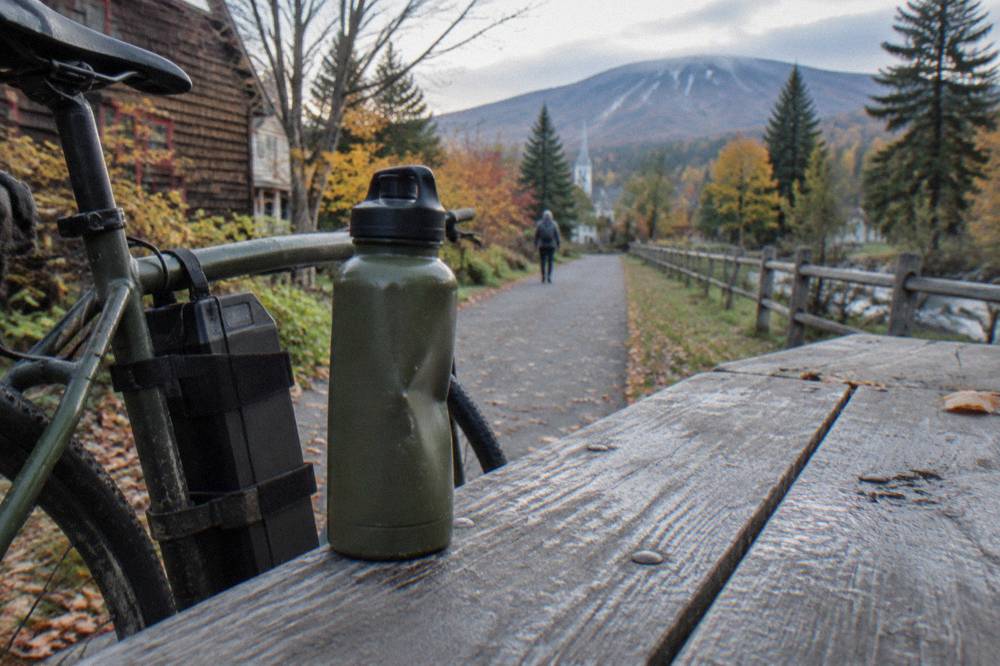
The practical rules that follow from this are simple. Ride the flats and descents on low assist or none, and save the boost for the pitches. Plan lunch or a coffee stop within reach of a plug, and ask before borrowing an outlet, most cafes in bike towns are used to the question. Carry the charger on multi-day trips, because innkeepers will usually let a battery charge overnight in a mudroom. And know the bail-out points on your route: Vermont's towns are close enough together that a dead battery rarely means a disaster, only an honest pedal home on a heavy bike.
The payoff for managing all this is that an e-bike effectively lengthens the day. A rider comfortable on 25 miles of mixed terrain can plan 40, which in Vermont is the difference between a town loop and a real point-to-point, say a rail trail section between two inns with a climb detour in the middle. That is the whole appeal of e-bike touring compressed into one decision.

The anchor rental source is Local Motion's Trailside Center at 1 Steele Street in Burlington, on the path itself, which rents Class 1 e-bikes alongside conventional, adaptive and kids bikes, daily with reservations recommended. In the Burke area, East Burke Sports, Kingdom Bike Rentals, Village Sport Shop and Rifugio Darling Hill all supply e-bikes, with Kingdom Bike Rentals focused on delivery and eMTBs. Rental prices are set by each shop and change often enough that this site does not print them, so check with the shop directly before locking a plan. The landscape beyond those two clusters thins out. Town bike shops in Stowe, Middlebury and the Mad River valley rent conventional bikes widely, but pedal-assist inventory is narrower, and a multi-day e-bike trip is easier to build around Burlington or the Northeast Kingdom, where the rental fleets actually live.
| Rental source | Location | E-bike offering | Good for |
|---|---|---|---|
| Local Motion Trailside Center | 1 Steele Street, Burlington, on the path | Class 1 pedal-assist e-bikes, plus conventional, adaptive and kids bikes | Island Line Trail and Burlington Greenway days |
| East Burke Sports | East Burke, at the trailhead | Full service shop near Kingdom Trails | eMTB weekends |
| Kingdom Bike Rentals | Burke area, mobile delivery | eMTB focus with delivery | Riders staying outside the village |
| Village Sport Shop | Darling Hill area | Rental fleet near the network | Kingdom Trails trips |
| Rifugio Darling Hill | Darling Hill | eMTB and full suspension options | Riders basing on the hill itself |
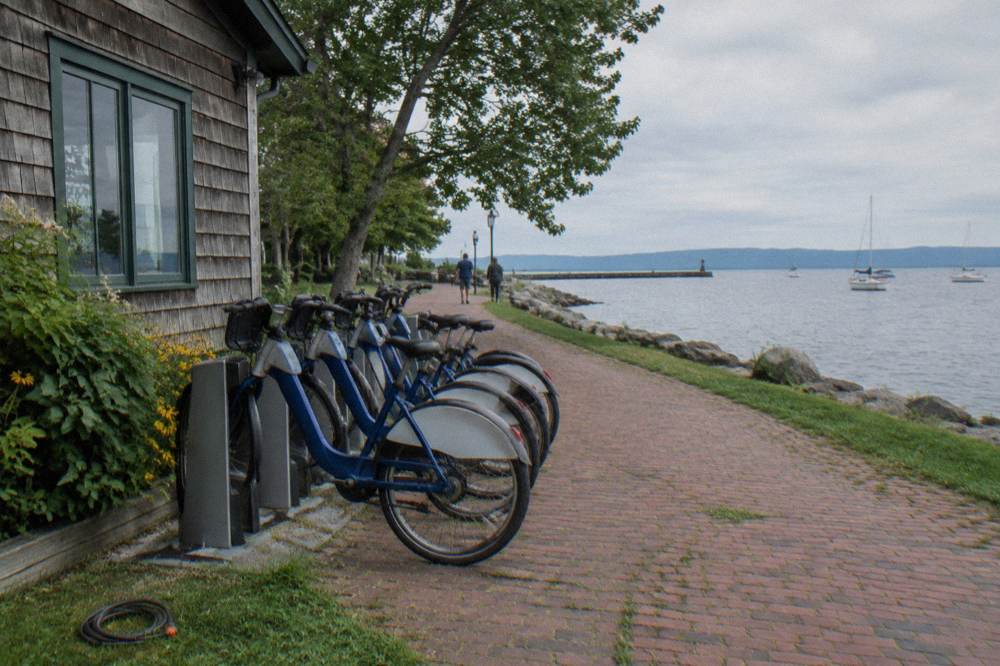
The Burlington option deserves the detail because it is the easiest e-bike day in Vermont to arrange. The Trailside Center sits on the waterfront path, minutes from the start of the Island Line Trail, so a renter can be on the causeway within the first mile and never touch a road. Reservations are recommended, and the rental proceeds support the nonprofit's trail advocacy work, which is a nice alignment: the fee helps build the paths you are riding. For a longer read on that corridor, see our Island Line Trail biking guide. North Burke riders planning a Kingdom Trails trip will find more in the Kingdom Trails rentals and guided rides guide, including how the shops split their territories.
The best base is the town whose riding starts at the door: Burlington for the Island Line Trail and the Greenway, Stowe for the recreation path and Mountain Road loops, and the Burke or Lyndonville area for Kingdom Trails. Because the e-bike rental fleets cluster in those same three places, sleeping near the riding also means sleeping near the bike supply. In Burlington, the practical choice is the waterfront end of downtown. Hotel Champlain Burlington sits steps from Waterfront Park and the bike path access, and its listing includes free bicycle rentals, which covers the backup bike if the e-bike day falls through. A shade inland, Hotel Vermont sits about 0.2 miles from the Burlington Bike Path, close enough that rolling the bike out the door and riding is the whole commute.
Stowe works differently. The town's riding fans out from the Stowe Recreation Path, and a base near the village puts both the path and the Mountain Road climbs within a warm-up. The Sun & Ski Inn And Suites is positioned exactly for that, as a Stowe base for the recreation path and the road loops around the village, while riders wanting a resort-scale version of the same can look at the Lodge at Spruce Peak up the mountain.
Burlington, near Waterfront Park
Steps from Waterfront Park and the bike path access; its listing includes free bicycle rentals.
Check ratesFor Kingdom Trails, the calculus is about the shuttle as much as the bed. The Wildflower Inn in Lyndonville sits 2.3 miles from Kingdom Trails, offers bike rentals and, usefully, a bicycle shuttle, which solves the classic Northeast Kingdom problem of riding a big loop and finishing far from where you started. Booking any of these is direct and ordinary; nothing about an e-bike trip requires special lodging, only an outlet and a ground floor.
Yes, though the market is small and the honest answer is that most Vermont bike touring is self-guided. VBT Bicycling Vacations is the established name, running supported trips where an e-bike can generally be requested for the riding days, while Great Bike Tours, Lamoille Valley Bike Tours and Vermont Mountain Bike Tours serve smaller niches. All are booked directly with the operator. What a supported trip adds is logistics: luggage moved between inns, a route designed and documented, and often a support vehicle within reach on the long days. On an e-bike trip the calculus shifts slightly, because the bike itself removes some of the fatigue a support system exists to absorb. Riders who want the structure still have it; riders who do not can assemble the same itinerary from rentals and inns without much difficulty, since Vermont's riding towns are close together and the rail trails stitch several of them into a line.
The question to ask any operator is the same one this guide keeps returning to: what class of e-bike, and where do you ride it? A trip built on rail trail corridors can carry any compliant bike, while anything touching state land singletrack needs the Class 1 pedal-assist conversation had in advance. Operators know the rules; confirming them costs one email. For the wider decision framework, our how to choose a Vermont bike tour guide and the guided versus self-guided comparison walk through the trade-offs, and VBT Bicycling Vacations publishes its own trip details directly.
Pick one corridor and ride it end to end rather than looping from a single base. The Lamoille Valley Rail Trail is the natural spine, 95 miles of under-3-percent grades through 18 towns, with inns at sensible intervals and charging available every night. Kingdom Trails offers the opposite shape, a single-area trip where the same trailhead serves four days of different singletrack. The rail trail model is the easiest introduction to e-bike touring in the state. Because the grade never presses, battery anxiety mostly disappears, and the daily distances become a matter of appetite rather than physics. Towns along the corridor are small but real, with food and beds, and the compacted stone surface suits any bike with tires wider than a racing slick. Riders who want a shorter version can take a single section; our Lamoille Valley Rail Trail biking guide breaks the trail into rideable pieces.
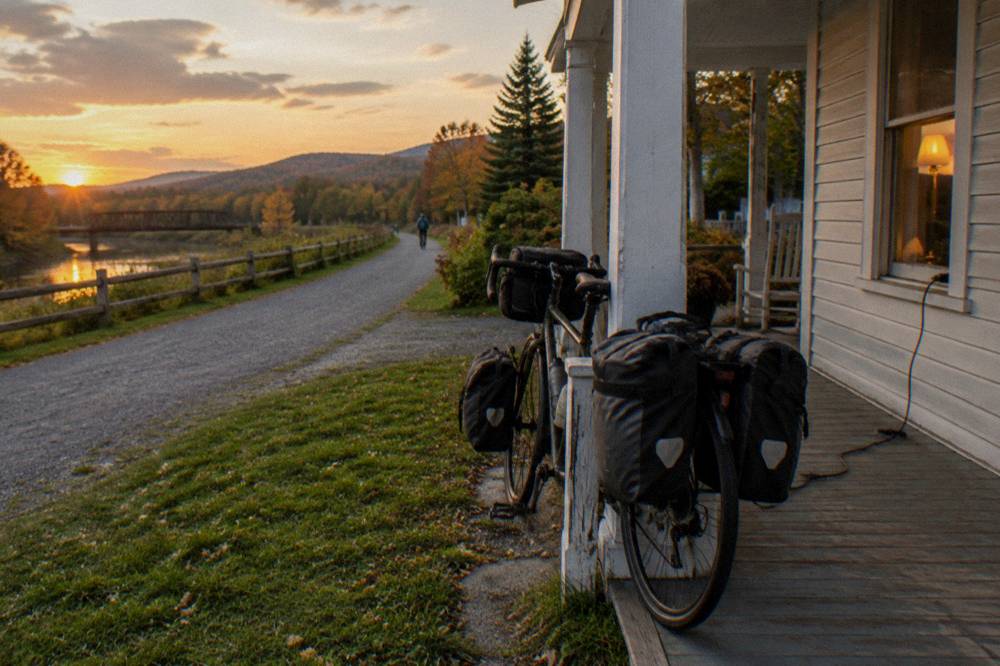
The Kingdom Trails model is a base-area trip. Rent an eMTB from one of the Burke shops, stay within shuttle distance, and ride a different sector of the 213-trail network each day, checking trail status each morning because the network closes when conditions are poor and shuts for the late autumn hunting season before the winter grooming begins. A five-day version of this trip barely scratches the map, which is the point.
| Trip shape | Corridor or area | Daily distance | Battery strategy | Rentals nearby |
|---|---|---|---|---|
| Rail trail point-to-point | Lamoille Valley Rail Trail, St. Johnsbury to Swanton | 20 to 40 miles | Charge nightly at inns; grades are gentle | Arrange pickup or bring your own |
| Lake day ride | Island Line Trail, Burlington to South Hero | 14.4 miles one way | One charge covers the round trip easily | Local Motion Trailside Center |
| Singletrack base trip | Kingdom Trails, East Burke | Rider's choice daily | Charge nightly; spare batteries at shops | East Burke Sports, Kingdom Bike Rentals, Village Sport Shop, Rifugio Darling Hill |
| Village loops | Stowe Recreation Path and Mountain Road | 10 to 30 miles | Charge nightly at the inn | Arrange in advance in Stowe |
Two planning constants apply everywhere. Check trail status before a long ride, since Vermont's trails close for mud, flood repair and hunting seasons, and the managers publish current conditions. And build a non-riding hour into each afternoon, because the reason to ride Vermont slowly is the state itself: a swimming hole, a bakery, a covered bridge that deserves more than a rolling glance.
The riding season runs roughly May to mid October, and the best window depends on the priority: summer for long days and full services, early fall for foliage from late September to mid October, with the caveat that October's shorter days and near-freezing mornings tax both the rider and the battery. The Island Line bike ferry runs late May to mid October, which effectively brackets the lake-riding season. Foliage is the marquee draw, and the timing moves with elevation: the statewide peak typically falls in early October, with northern ridgelines turning up to two weeks ahead of the southern valleys, so the classic sequence is to ride the Northeast Kingdom first and drift south through the month. October averages a high near 56F and a low near 36F, with sunrise near 7:00 and sunset near 6:20 early in the month, which means the comfortable riding window sits between mid morning and late afternoon.
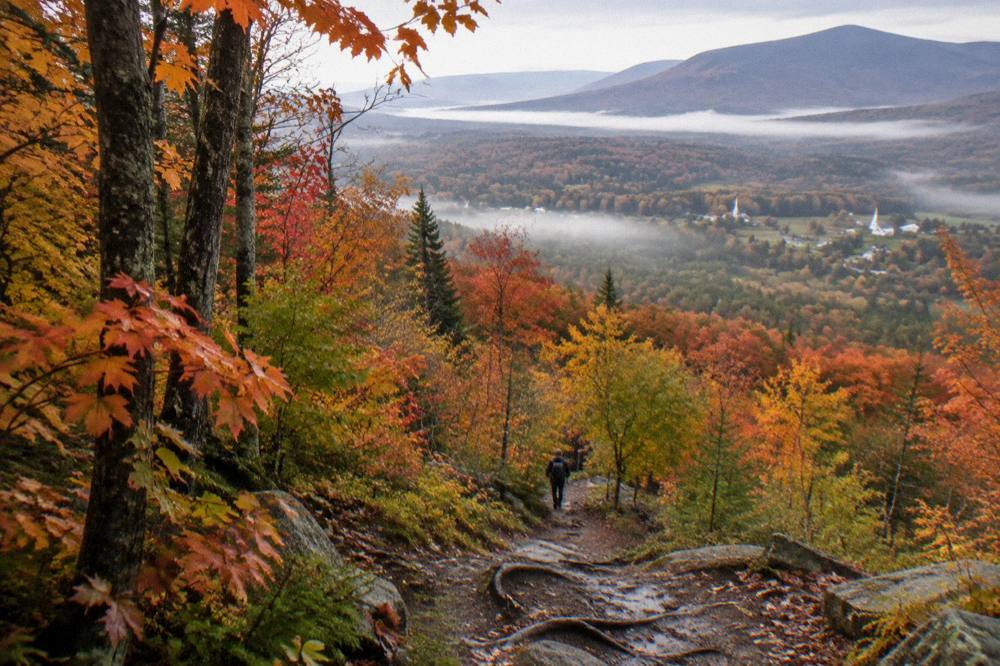
An e-bike shapes the seasonal choice in one specific way: cold reduces battery output, so late-season riders should plan shorter days or carry the charger to lunch. Against that, the motor makes the cool-weather dress question simpler, since a rider working at assist level two sweats less than one grinding every hill, and October layers matter less when the effort is steady. Kingdom Trails' summer season typically runs to the end of October before the network closes for hunting and reopens as a groomed winter system for fat bikes, so the singletrack window closes a little earlier than the road window. Riders chasing the very best color can cross-check with our fall foliage peak dates by region guide.
Whatever the month, the same three checks apply: the trail conditions page for the network you are riding, the ferry schedule if the route crosses the causeway gap, and a weather forecast read with hills in mind, since a valley forecast understates what the ridgeline is doing. Vermont Biking Tours keeps guides to each of these corridors current for exactly that pre-ride hour.
Lyndonville, 2.3 miles to Kingdom Trails
Offers bike rentals and a bicycle shuttle, and sits 2.3 miles from Kingdom Trails.
Check ratesYes. E-bikes are allowed on the Lamoille Valley Rail Trail under the state rail trail rules, which permit all non-motorized uses and treat compliant e-bikes as bicycles. ATVs, dirt bikes, motorized scooters and similar machines are prohibited, and snowmobiles use the corridor only within the designated winter season.
Class 1 pedal-assist eMTBs are allowed on most Kingdom Trails trails per the Kingdom Trails Association, but not every trail or landowner parcel permits them, so check the current trail map for exclusions before riding. Higher classes and throttle-driven machines are not part of the allowance.
Not on non-motorized natural-surface trails. Vermont's state land rules allow e-bikes on roads and designated multi-use paths and prohibit them on natural-surface trails, though a policy to expand Class 1 access has been under review. The Vermont Mountain Bike Association publishes the current position.
Class 1 and Class 2 e-bikes assist up to 20 mph and Class 3 up to 28 mph, under the state's three-class system, with motors capped under 750 watts. Class 3 bikes require a minimum operator age of 16 and a speedometer. Beyond 28 mph or 750 watts the machine is no longer an e-bike in law.
Local Motion's Trailside Center at 1 Steele Street in Burlington rents Class 1 e-bikes on the waterfront path, with reservations recommended. In the Burke area, East Burke Sports, Kingdom Bike Rentals, Village Sport Shop and Rifugio Darling Hill all supply e-bikes. Rental prices vary, so check with each shop directly.
No. Compliant e-bikes in all three classes are treated as bicycles in Vermont, so no license, registration or insurance applies. A helmet is always advised, whatever the rider's age, and rental shops set their own minimum ages for their fleets.
Before you go, the pick for this guide:
Hotel Vermont
About 0.2 miles from the Burlington Bike Path in the lake-side downtown.
Check rates →