Are E-Bikes Allowed In Vermont?
Where e-bikes are legal in Vermont: road rules, the three-class system, rail trails like the LVRT, Kingdom Trails, and state land limits, in plain terms.
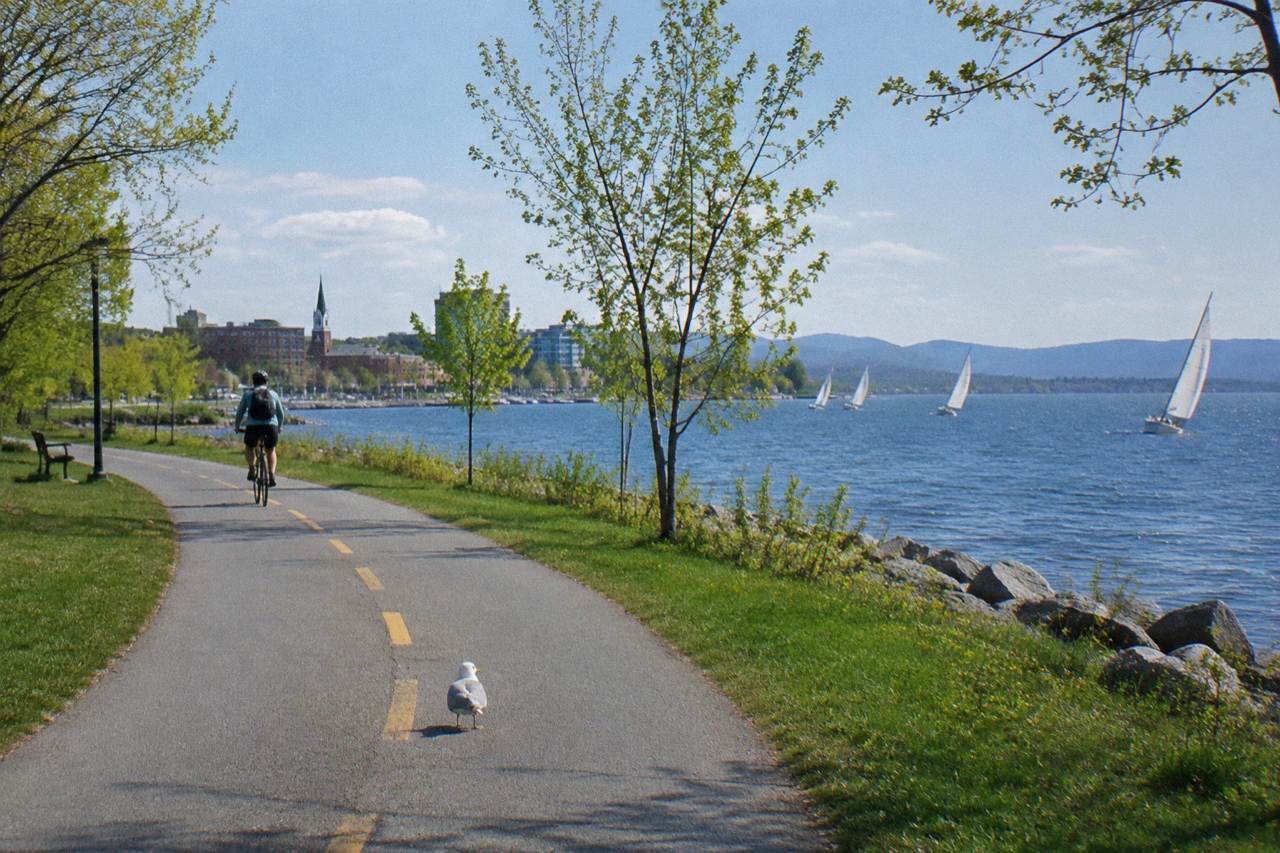
Yes, e-bikes are allowed in Vermont. The state uses a three-class system and treats compliant e-bikes as bicycles, so they ride on roads and most multi-use paths without a license or registration. The limits come from surface and manager: state land bars them from non-motorized natural-surface trails, and private networks set their own rules. Riding an e-bike here comes down to knowing which class you have and where the boundary lines sit.
Vermont E-Bike Law At A Glance
Yes. Vermont classifies e-bikes into three classes and treats them as bicycles under state law, meaning no license, registration or insurance is needed to ride one on public roads. Class 1 and Class 2 bikes assist up to 20 mph and Class 3 up to 28 mph, with motors under 750 watts. The operator of a Class 3 bike must be at least 16. In practice that puts e-bikes on roads, paved paths and most rail trails statewide.
That legal framing matters because it removes the ambiguity that e-bike riders face in states with patchwork rules. Vermont adopted a three-class framework, the same structure used in much of the country: Class 1 is pedal assist only, Class 2 adds a throttle, and Class 3 is a faster pedal-assist bike that needs a speedometer and label. All three are bicycles in the eyes of Vermont law as long as the motor stays under the wattage cap.
Where things get interesting, and where riders actually get confused, is the layer below the state law. Land managers, cities and private trail networks can impose their own restrictions, and in Vermont they do. The City of Burlington permits Class 1 pedal-assist e-bikes where bicycles are allowed on its Greenway and prohibits throttle-driven e-motorcycles. The state's rail trail program allows e-bikes outright. State forests and parks currently do not allow them on natural-surface singletrack. None of that contradicts the state law, it just fills in the terrain-specific detail.
So the honest answer is yes, with a map. If you are riding pavement, stone dust rail trail or a municipal path, you are almost certainly fine on a compliant e-bike. If you are heading onto dirt singletrack, the question becomes who owns the trail, and that is what the rest of this article works through, section by section, with the riding decisions a visiting cyclist actually makes.
For anyone planning a biking trip around this, the class label on your bike is the first thing to check: the sticker or etching on the frame states the class and top assisted speed, and it is what a ranger or trail steward will look at if a question comes up.
What Are The Three E-Bike Classes In Vermont?
Vermont recognizes Class 1, Class 2 and Class 3 e-bikes, all capped at motors under 750 watts. Class 1 assists only while you pedal, up to 20 mph. Class 2 adds a throttle, also to 20 mph. Class 3 assists up to 28 mph, requires a speedometer and label, and its operator must be at least 16, though a younger rider may ride as a passenger if the bike is designed for it.
The distinctions sound bureaucratic until you hit the first trailhead sign, at which point they decide whether you ride or turn around. Class 1 is the least restricted category almost everywhere in Vermont: rail trails allow it, Burlington's path network allows it, and Kingdom Trails allows Class 1 pedal-assist mountain bikes on most of its network. Class 2's throttle is where some land managers draw a line, reasoning that throttle power behaves more like a motor vehicle than a bicycle on shared paths. Class 3's higher assist speed makes it the road-oriented class, and it is the one with the minimum operator age attached.
A practical note for rental riders: Vermont shops and nonprofit rental fleets generally rent Class 1 bikes, which sidesteps the restrictions entirely. Local Motion's Trailside Center in Burlington rents Class 1 pedal-assist e-bikes alongside conventional, adaptive and kids' bikes, and the same pattern holds at rental shops near the mountain bike networks in the northeast of the state.
| Class | How it assists | Top assisted speed | Where it stands in Vermont |
|---|---|---|---|
| Class 1 | Pedal assist only | 20 mph | Broadest access: roads, rail trails, Burlington paths, most of Kingdom Trails |
| Class 2 | Pedal assist plus throttle | 20 mph | Treated as a bicycle statewide; some shared paths prefer pedal assist |
| Class 3 | Pedal assist, faster | 28 mph | Road-oriented; operator must be 16 or older, speedometer and label required |
All three remain bicycles rather than motor vehicles, which is why none of them requires registration. The wattage cap is the hard ceiling: above 750 watts, or on a throttle-only machine built like a small motorcycle, you are outside the e-bike definitions and into a different regulatory conversation.
Can You Ride An E-Bike On Vermont Roads?
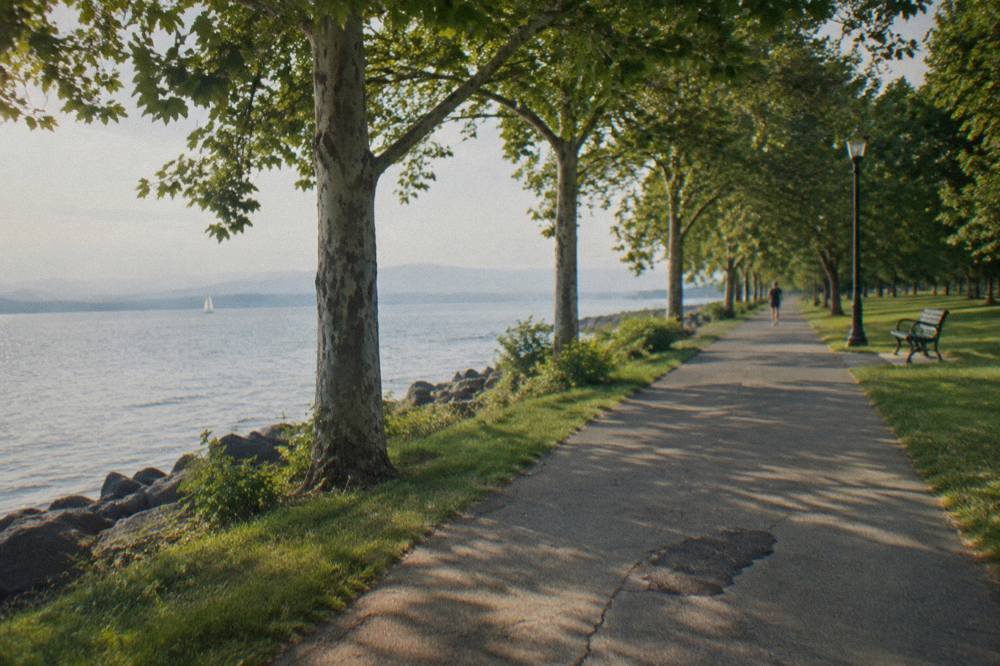
Yes. Because Vermont treats compliant e-bikes as bicycles, they are legal on public roads under the same rules that apply to any cyclist, without registration or a driver's license. Riders follow standard bicycle law, riding as far to the right as is safe. Vermont's rural roads are often narrow with limited shoulders, so route planning matters as much as legality.
The road network is where e-bikes and conventional bikes are closest to interchangeable. A Class 3 bike makes sense for road riding precisely because the 28 mph assist matches the flow of traffic on the rolling two-lane roads between Vermont villages, and nothing in state law excludes it. The practical caveats are terrain and traffic rather than rules: many secondary roads have little or no shoulder, paved climbs between towns are steep enough to drain a battery faster than flatland riding, and popular scenic corridors carry leaf-season car traffic in the fall.
Battery math deserves a place in road planning. Vermont's terrain is short steep climbs and long descents rather than flat grinding, which is friendlier to range than a rider might fear, but a hilly century-style loop in the Green Mountains will work a battery harder than the same distance on the rail trail. Riders report that carrying the charger and planning a lunch stop with an outlet is the standard move for bigger road days.
For road cyclists weighing formats, the road versus gravel versus e-bike comparison covers how the three styles split across Vermont's terrain, and it is worth reading before committing to a rental type for a week.
Are E-Bikes Allowed On The Lamoille Valley Rail Trail?
Yes, explicitly. The official Lamoille Valley Rail Trail page states that e-bikes are allowed on the full route, a 95-mile stone-dust trail running from St. Johnsbury to Swanton through 18 towns, making it the longest rail trail in New England. All non-motorized uses are permitted year-round. What is barred is the motorized category: ATVs, dirt bikes, motorized scooters and segways, with snowmobiles allowed only in their designated winter season. For the full picture on class rules and planning tips, see our guide to e-bike rules on the Lamoille Valley Rail Trail.
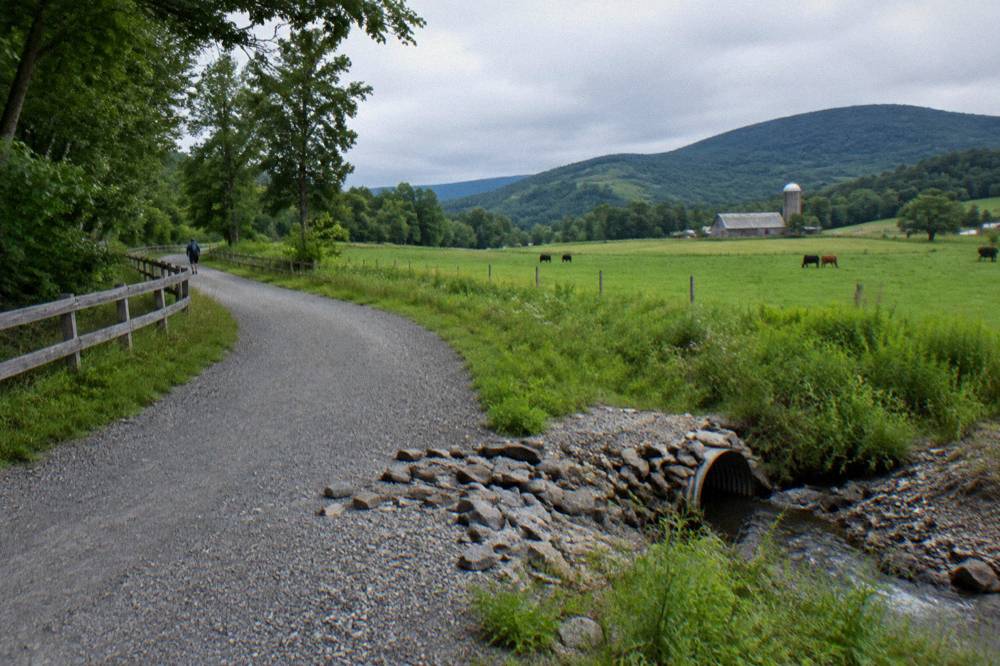
That "e-bikes are allowed" line on the state's own rail trail page is the single clearest statement of e-bike access anywhere in Vermont, and it is worth internalizing because the trail is one of the best e-bike touring surfaces in the region. The surface is a firm, compacted crushed stone about ten feet wide with a grade under three percent end to end, built on a railroad bed. That combination, gentle grade plus a firm wide surface, is close to ideal for e-bikes of every class and for riders of every fitness level.
The Missisquoi Valley Rail Trail, a 26.4-mile route from St. Albans to Richford, joins the Lamoille near Sheldon, and the same non-motorized framework applies across the state rail trail network. For an e-bike itinerary, the LVRT's town spacing is the draw: villages with food and lodging sit at intervals that suit a battery-assisted day of riding, and the flat grade means even a modest-range bike can string several towns together.
Two planning notes from the trail's own updates: short segments occasionally close for maintenance or flood repair, and a trailhead here or there may be temporarily rerouted, so check trail status before a long ride. The trail is open year-round, which matters for anyone riding in the quieter shoulder seasons when the foliage crowds are gone but the stone surface still rolls well.
Riders basing in Burlington for a rail trail day have a straightforward launch: the Burlington bike path guide covers the lake-side network that connects toward the causeway riding, and the city's own path rules mirror the state's bicycle treatment of e-bikes.
Are E-Bikes Allowed On The Burlington Bike Path And Island Line Trail?
Yes, on Class 1 terms. Burlington permits Class 1 pedal-assist e-bikes where bicycles are allowed, which includes the Burlington Greenway and the Island Line corridor out onto the Colchester Causeway. Throttle-driven machines that behave like small motorcycles are prohibited. The Greenway segment is about 8 miles paved, with roughly 5 more miles of crushed gravel on the causeway towards South Hero.
The Island Line is the showpiece ride of the Burlington area, about 14.4 miles from the waterfront to South Hero, much of it on a causeway crossing Lake Champlain with water on both sides. It is exactly the kind of ride an e-bike opens up for riders who do not want to earn their miles into a headwind, and the city's access rules are built around the Class 1 distinction rather than a blanket e-bike ban. More of these guides are collected on Vermont Biking Tours.
One seasonal detail changes the itinerary: the Local Motion bike ferry that carries riders across the gap in the causeway runs late May to mid October and is donation based, and it closes between seasons. Riders planning a causeway crossing should check the ferry page before committing, because without the ferry the ride turns around at the gap. The same nonprofit operates the Trailside Center at 1 Steele Street, right on the path, renting Class 1 e-bikes with reservations recommended.
For visitors staying in the city, the ride genuinely starts at the door. Hotel Champlain Burlington, Curio Collection by Hilton, sits steps from Waterfront Park and the bike path access, and its listing includes free bicycle rentals, which makes the Greenway a zero-logistics first ride. The lake-side downtown puts a rider on the path within minutes of leaving the lobby, headed north toward the causeway.
Hotel Champlain Burlington, Curio Collection by Hilton
Burlington, near Waterfront Park
Steps from Waterfront Park and the bike path access; its listing includes free bicycle rentals.
Check ratesAre E-Bikes Allowed At Kingdom Trails?
On most of the network, yes, if the bike is Class 1. The Kingdom Trails Association allows Class 1 pedal-assist eMTBs on most trails, with the trail map flagging landowner exclusions. That is a private, landowner-permission network of more than 100 miles of non-motorized singletrack and multi-use trail on 213 named routes near East Burke, and passes are required, bought online or at the Welcome Center on VT Route 114.
The word "most" is doing real work in that policy, and it exists because Kingdom Trails runs across dozens of private landowners who each retain a say. The association's ride-with-gratitude framework asks riders to respect the map's exclusions, and e-bike riders specifically should open the trail map and check which routes carry an e-bike restriction before planning a loop. This is not a burden so much as a habit: the same map check that avoids a closed trail for mud also avoids an excluded trail for the motor.
Rental availability in the Burke area leans into the policy. East Burke Sports operates at the trailhead, Kingdom Bike Rentals runs a delivery-oriented fleet with an e-MTB focus, Village Sport Shop sits up on Darling Hill, and Rifugio Darling Hill rents eMTBs as well. Rental prices are not published in a verified form, so ask the shop directly. All of them rent Class 1 machines that fit the network's rules, which removes the compliance question for visitors who arrive without a bike.
The summer season typically runs from when conditions allow in May to the end of October, with the network closing for late-autumn deer hunting before a groomed winter fat-bike and Nordic operation opens on designated trails. Fat bikes with tires wider than 3.5 inches get a designated winter subset, and trail status is published on the conditions page, worth a check before any long drive north.
Our sibling article on the question goes deeper: e-bike access at Kingdom Trails covers the exclusions and riding etiquette in detail.
Where Are E-Bikes Not Allowed In Vermont?
The main exclusion is state-owned natural-surface trail. On Vermont state forests and parks, e-bikes are currently prohibited on non-motorized natural-surface singletrack, while remaining allowed on roads, paved paths and designated multi-use trails. The Vermont Mountain Bike Association, which tracks this closely, reports a proposed policy that would expand Class 1 access on state land, but adoption is unconfirmed.
This is the boundary that catches mountain bikers. The state's Department of Forests, Parks and Recreation manages a large share of Vermont's public dirt singletrack, and its current reading of motorized use puts e-bikes on the wrong side of the non-motorized line on those trails, even Class 1 pedal-assist ones. Bikes are welcome on park roads and designated multi-use paths. The Vermont Mountain Bike Association's policy page is the clearest single reference for where this stands, and it is the source to recheck, because the proposed expansion has been in public comment and the details could move.
The practical picture for a rider planning a trip is a patchwork with a logic to it:
| Riding surface | E-bike access | Who sets the rule |
|---|---|---|
| Public roads | All classes, as bicycles | State law |
| State rail trails (LVRT, Missisquoi) | Allowed, all non-motorized uses | State rail trail program |
| Burlington Greenway and Island Line | Class 1 pedal assist | City of Burlington |
| Kingdom Trails (private network) | Class 1 eMTB on most trails, map exclusions apply | Kingdom Trails Association and landowners |
| State land natural-surface singletrack | Currently prohibited | Department of Forests, Parks and Recreation |
Two follow-on points keep the patchwork honest. First, private land and municipal networks beyond the big names set their own terms, so a local land trust's singletrack may differ from the neighboring town's, and a sign at the trailhead is the final word. Second, the West River Trail in the southern part of the state illustrates the fine-grain version: its rules limit e-bikes to pedal assist under 750 watts with a speed cap, and prohibit e-motorcycles outright. Surface, manager and sometimes the individual trail all matter.
For gravel riders, the rules are friendlier, since gravel riding happens on roads and multi-use corridors where e-bikes are squarely allowed. The Vermont gravel riding guide maps where those routes sit, and nothing in the e-bike framework blocks a Class 1 bike from joining them.
Do You Need A Helmet Or License For An E-Bike In Vermont?
No license, registration or insurance is required for any compliant e-bike class in Vermont, since the state treats them as bicycles. Helmets are strongly advised for every rider, and this site's standing recommendation is simply to wear one on every ride, e-bike or not. Age rules do apply in one place: the operator of a Class 3 bike must be at least 16.
Because the e-bike is legally a bicycle, the licensing question answers itself. There is no plate, no permit and no insurance mandate, which is the same treatment a conventional bike receives. Rental fleets add their own terms, which is a contractual matter rather than a legal one: Local Motion's rentals, for instance, restrict e-bike renters to riders 18 and older, or 16 and older with a guardian along. That is the shop's policy on its fleet, not state law, and it is typical of rental operations everywhere.
On helmets, the honest position is advice rather than statute. Helmet requirements for cyclists vary by state and rider age, and the specific Vermont provisions are the kind of detail worth confirming on the official statute rather than trusting a summary for. What does not vary is the physics: e-bikes add speed and weight to a fall, and the assisted speeds of even a Class 1 bike on a gravel descent justify a helmet more, not less, than an unassisted ride. Wear one, make guests wear one, and treat the rental shop's included helmet as part of the bike rather than an optional extra.
Riding behavior rules carry over unchanged from bicycle law. Riders keep to the right where safe, use lights after dark, and on shared paths yield the courtesy that multi-use etiquette expects, since an e-bike's quiet approach is the thing pedestrians least anticipate. None of that is e-bike specific, but a motor makes each of it matter slightly more.
Where Should You Stay For An E-Bike Trip In Vermont?
Match the base to the riding you came for. Burlington puts you on the Greenway and Island Line with Class 1 rentals at the path's edge. Stowe centers you on the Recreation Path and the road loops around the village. The Lyndonville area, near East Burke, is the choice for Kingdom Trails riding, and The Wildflower Inn there sits 2.3 miles from the trail network with bike rentals and a bicycle shuttle of its own.
The lodging decision is really a trailhead decision. In Burlington, a stay near the waterfront turns the e-bike question into a walking-distance one, since the path, the rentals and the causeway ride all thread together from the downtown lake shore. The Island Line riding guide lays out how those pieces connect into a day.
In the northeast, the calculus shifts to shuttle logistics and trail proximity. An eMTB trip to Kingdom Trails rewards a base that removes the drive entirely, and The Wildflower Inn covers that: it rents bikes and runs a bicycle shuttle while sitting 2.3 miles from the network, which for an e-bike is a warm-up spin or a two-minute shuttle hop. The lodging there also positions a rider for the LVRT's northern stretches, since the trail's eastern sections pass through the same part of the state.
Stowe splits the difference between road and path riding. The Sun & Ski Inn And Suites works as a base for the Stowe Recreation Path and the road loops around the village, both of them surfaces where a Class 1 bike rides without restriction. Those loops are a good fit for mixed-ability groups, since the assisted riders and the unassisted riders can share the same route without the climbs breaking the group apart.
The Wildflower Inn
Lyndonville, 2.3 miles to Kingdom Trails
Offers bike rentals and a bicycle shuttle, and sits 2.3 miles from Kingdom Trails.
Check ratesIs Vermont A Good State For An E-Bike Vacation?
Yes, and arguably better than its reputation suggests. The rail trail network is long, flat and explicitly e-bike friendly, the road riding links villages at battery-friendly distances, and the marquee mountain network allows Class 1 eMTBs on most trails. The one gap, state-land singletrack, is real but avoidable with a little planning around private networks like Kingdom Trails.
What makes Vermont work for e-bikes is the same thing that makes it work for bikes generally: short climbs, town spacing and a surface for every mood. A visitor can ride a stone-dust rail trail on Monday, a lakeside causeway on Tuesday and a rooty singletrack loop on Wednesday, and the e-bike rules accommodate all three, with the single caveat of state-land dirt trails. The guide to Vermont e-bike trips covers how operators build tours around that variety for riders who want logistics handled.
The seasonal angle matters too. Foliage season, late September to mid October, is the marquee draw, and October riding conditions run roughly high 50s by day and high 30s at night, crisp and dry more often than not. Daylight shortens through the fall, with sunrise near 7 and sunset a bit after 6 in the early part of the month, so an e-bike's speed budget helps fit a full loop into the light. Backroads stay quiet midweek while the famous scenic corridors carry leaf-season cars, which is an argument the rail trails settle entirely: no cars at all.
Whatever the season, the standing advice from every trail manager in the state is the same: check trail status before a long ride. Flood repairs, mud closures and seasonal gates move around, and the conditions pages published by the networks themselves are the live source. Bring the charger, wear the helmet, read the class sticker, and Vermont's trails, paths and roads are open.
Common Questions About E-Bikes In Vermont
Are E-Bikes Allowed In Vermont?
Yes. Vermont treats compliant e-bikes as bicycles under a three-class system, with no license, registration or insurance required. They are legal on roads and most multi-use paths, explicitly allowed on the state rail trails, permitted as Class 1 machines on most Kingdom Trails routes, and currently barred from non-motorized natural-surface trails on state land.
Are E-Bikes Allowed On The Lamoille Valley Rail Trail?
Yes. The official trail page states that e-bikes are allowed on the full 95-mile route from St. Johnsbury to Swanton, alongside all other non-motorized uses. ATVs, dirt bikes, motorized scooters and segways are prohibited, and snowmobiles use the trail only in their designated winter season.
Can You Ride A Class 2 Or Class 3 E-Bike In Vermont?
Both are legal on the state's roads under the same three-class framework. Class 2 adds a throttle up to 20 mph, and Class 3 assists to 28 mph with a 16-year minimum operator age and a required speedometer and label. Some shared-use paths and private trail networks admit only Class 1 pedal-assist bikes, so check the specific surface.
Are E-Bikes Allowed At Kingdom Trails?
Class 1 pedal-assist eMTBs are allowed on most of the Kingdom Trails network per the Kingdom Trails Association, with the trail map marking landowner exclusions. A pass is required and can be bought online or at the Welcome Center on VT Route 114 in East Burke. Check the association's store for current pass prices.
Where Are E-Bikes Banned In Vermont?
The main exclusion is state-owned land: e-bikes are currently prohibited on non-motorized natural-surface trails in Vermont state forests and parks, while remaining allowed on park roads and designated multi-use trails. The Vermont Mountain Bike Association reports a proposed policy that would expand Class 1 access, but adoption is unconfirmed, so check its policy page.
Do You Need A Helmet Or License For An E-Bike In Vermont?
No license, registration or insurance is required, since e-bikes are treated as bicycles. Helmet provisions vary by age and are worth confirming on the official statute, but the plain advice is to wear one on every ride. Rental fleets set their own age minimums, commonly 18 or older, or 16 with a guardian.